2.Making of the Constitution chapter 2Polity Laxmikant
3.Featues of Indian Constitution chapter 3 Polity Laxmikant
4.Peamble chapter 4 Polity Laxmikant
5.Union and its Territories chapter 5 Polity Laxmikant
6.Citizenships chapter 6 Polity Laxmikant
7. Fundamental Rights chapter 7 Polity Laxmikant
22
This summary covers the key structural and functional aspects of the Parliament (Part V, Articles 79–122) as detailed in M. Laxmikanth’s Indian Polity.
I. Organisation of Parliament
- Three Parts: Consists of the President, Rajya Sabha (Council of States), and Lok Sabha (House of the People).
- The President’s Role: Though not a member of either House, the President is an integral part because no Bill becomes law without their assent. They also summon/prorogue sessions and dissolve the Lok Sabha.
- Mnemonic for Parts: PRL (President, Rajya sabha, Lok sabha) – The “Pearl” of Indian Democracy.
II. Composition and Duration
- Rajya Sabha (Upper House):
- Strength: Max 250 (238 elected, 12 nominated by President for expertise in art, science, etc.).
- Nature: A permanent body; one-third of members retire every second year. Each member has a 6-year term.
- Lok Sabha (Lower House):
- Strength: Max 550 (originally 552; Anglo-Indian nomination ended in 2020).
- Nature: Not permanent; usual term is 5 years but can be dissolved earlier by the President.
III. Membership and Disqualification
- Qualifications: Must be a citizen of India; age ≥30 for Rajya Sabha and ≥25 for Lok Sabha.
- Disqualifications (Art 102): Holding an office of profit, being of unsound mind, undischarged insolvent, or not being a citizen.
- Anti-Defection Law (10th Schedule): Members are disqualified if they voluntarily give up party membership or vote against party whips.
IV. Presiding Officers
- Speaker (Lok Sabha): Elected by members. Decides if a bill is a Money Bill, presides over Joint Sittings, and maintains house decorum.
- Chairman (Rajya Sabha): The Vice-President of India is the ex-officio Chairman.
V. Sessions and Procedures
- Summoning: Gap between two sessions cannot exceed 6 months.
- Quorum: Minimum 1/10th of the total membership required to conduct business.
- Devices:
- Question Hour: First hour of a sitting for asking questions.
- Zero Hour: Time immediately following Question Hour for raising matters without prior notice.
- Motions: Tools like No-Confidence Motion (only in Lok Sabha) to test the government’s majority.
VI. Legislative Procedure
- Ordinary Bills: Can be introduced in either House; require simple majority.
- Money Bills (Art 110): Only introduced in Lok Sabha with President’s recommendation. Rajya Sabha has only 14 days to recommend changes.
- Joint Sitting (Art 108): Summoned by President to resolve deadlocks between Houses; presided over by the Speaker.
VII. Parliamentary Committees
- Financial Committees:
- Public Accounts Committee: Scrutinizes CAG reports.
- Estimates Committee: Largest committee (30 members, all from Lok Sabha); examines budget estimates.
- Public Undertakings Committee: Reviews performance of public sector units.
Retention Mnemonics & Q&A
- Mnemonic for Money Bill: “M” for Money, “M” for Majority in Lok Sabha (exclusive power).
- Mnemonic for Rajya Sabha members: “S-A-L-T” (Science, Art, Literature, Social Service) – criteria for nominated members.
Sample Q&A (Top 5 for Revision)
- Q: Who decides if a Bill is a Money Bill? A: The Speaker of Lok Sabha.
- Q: What is the maximum gap between two sessions? A: 6 months.
- Q: Is the President a member of Parliament? A: No, but they are an integral part.
- Q: Which committee has no members from Rajya Sabha? A: Estimates Committee.
- Q: Minimum age for Rajya Sabha membership? A: 30 years.
Would you like a deeper breakdown of Parliamentary Privileges or a specific list of Financial Powers next?



10 sites
- Laxmikanth Summary: Parliament – Indian Polity for UPSC …Organisation of Parliament * Under the Constitution, the Parliament of India consists of three parts: (i) The President. (ii) The …
EduRev
- LUXMIKANT POLITY CRUX NOTES-CHAPTER-22LUXMIKANT POLITY CRUX NOTES-CHAPTER-22 – DIADEMY IAS. LUXMIKANT POLITY CRUX NOTES-CHAPTER-22. Leave a Comment / By Rose / Parliame…
diademy ias
- Laxmikanth Indian Polity Chapterwise Summary | PDF – ScribdLaxmikanth Indian Polity Chapterwise Summary. The document provides a comprehensive chapter-wise summary of M. Laxmikanth’s ‘India…
Scribd
Show all
yes
Part 2: Deep Dive into Parliamentary Privileges & Financial Powers
Continuing from the previous summary, here are the critical technical areas of the Parliament chapter as per M. Laxmikanth.
VIII. Parliamentary Privileges (Article 105)
Privileges are special rights, immunities, and exemptions enjoyed by the two Houses, their committees, and their members to ensure effective discharge of functions.
- Collective Privileges:
- Right to publish reports/debates and prohibit others from doing so.
- Right to exclude strangers from galleries.
- Right to punish members or outsiders for breach of privilege or contempt of the House.
- Individual Privileges:
- Freedom of Speech: Members cannot be sued in court for anything said or any vote given in Parliament.
- Freedom from Arrest: Members cannot be arrested in civil cases 40 days before, during, and 40 days after a session. (Note: No immunity in criminal cases or preventive detention).
- Mnemonic: “S-A-P” (Speech, Arrest-free, Publishing) – The core of Member rights.
IX. Financial Powers & Budgetary Process
The Parliament exercises “power of the purse” through the following mechanisms:
- The Budget (Annual Financial Statement – Art 112):
- Presentation: Done by the Finance Minister on behalf of the President.
- General Discussion: Houses discuss the budget as a whole.
- Scrutiny by Departmental Committees: Committees examine the demands for grants.
- Voting on Demands for Grants: Exclusive to Lok Sabha. Members can move Cut Motions (Policy Cut, Economy Cut, Token Cut).
- Passing of Appropriation Bill: No money can be withdrawn from the Consolidated Fund of India without this Bill.
- Passing of Finance Bill: Legalizes the income/taxation side of the budget.
- Funds:
- Consolidated Fund of India (Art 266): All revenue and loans; requires Parliamentary law for withdrawal.
- Public Account of India (Art 266): Bank deposits, provident funds; handled by executive action.
- Contingency Fund of India (Art 267): Placed at the disposal of the President for unforeseen expenses; later recouped by Parliament.
X. 100-Point Rapid Revision (Selected High-Yield Q&A)
Structure & Composition
- Q: Is the Indian Parliament “Sovereign”? A: No, it is limited by a written Constitution and Judicial Review.
- Q: Who represents UTs in Rajya Sabha? A: Indirectly elected by members of an electoral college specially constituted.
- Q: Total nominated members in Parliament currently? A: 12 (All in Rajya Sabha; LS nominations abolished).
- Q: Who fixes the salaries of MPs? A: Parliament by law.
Motions & Devices
5. Q: Does a Prorogation affect pending bills? A: No.
6. Q: Does Dissolution of Lok Sabha lapse bills pending in Rajya Sabha but not passed by LS? A: No.
7. Q: Difference between Adjournment and Adjournment Sine Die? A: Adjournment specifies a time to reassemble; Sine Die does not.
8. Q: Who admits a No-Confidence Motion? A: The Speaker (requires support of 50 members).
Legislative Control
9. Q: Can Rajya Sabha vote on Demands for Grants? A: No, only discussion is allowed.
10. Q: What is Guillotine? A: Putting all remaining demands for grants to vote without discussion due to lack of time.
Retention Mnemonics for Parliamentary Terms
- Cut Motions (P-E-T):
- Policy Cut: Reduce demand to ₹1 (Strongest disapproval).
- Economy Cut: Reduce by a Specific Amount.
- Token Cut: Reduce by ₹100 (To air a specific grievance).
- Lapse of Bills (The “S-T-A-Y” Rule):
- Bills Started in LS always die on dissolution.
- Bills passed by LS and Transmitted to RS always die.
- Bills Awaiting President’s assent do not die.
- Yet to be settled via Joint Sitting do not die.
Would you like me to generate the full list of all 100 Questions and Answers in a table format, or shall we focus on the Legislative vs. Executive relations?
AI responses may include mistakes. For financial advice, consult a professional. Learn more
full list of 100 questions and answer
This list covers the most high-yield facts from the
Parliament chapter of M. Laxmikanth’s Indian Polity, organized for rapid revision.
Parliament: 100 Rapid-Fire Q&A
I. Composition & Basics (1-15)
- Q: Which Articles deal with Parliament? A: Articles 79 to 122.
- Q: What are the three components of Parliament? A: President, Rajya Sabha, Lok Sabha.
- Q: Is the President a member of either House? A: No.
- Q: Why is the President part of Parliament? A: Because Bills require Presidential assent to become Acts.
- Q: Max strength of Rajya Sabha? A: 250.
- Q: How many RS members are nominated? A: 12.
- Q: On what grounds are RS members nominated? A: Art, Literature, Science, Social Service (Mnemonic: LASS).
- Q: Max strength of Lok Sabha? A: 550 (formerly 552).
- Q: Which amendment abolished Anglo-Indian nomination? A: 104th Amendment Act, 2019.
- Q: What is the 4th Schedule related to? A: Allocation of seats in Rajya Sabha.
- Q: Who represents Union Territories in RS? A: Indirectly elected members.
- Q: What is the “Territorial Constituencies” basis? A: Population (Census 2001 currently).
- Q: Duration of Rajya Sabha? A: Permanent body (not subject to dissolution).
- Q: Term of an RS member? A: 6 years.
- Q: Normal term of Lok Sabha? A: 5 years.
II. Qualifications & Disqualifications (16-30)
- Q: Min age for Lok Sabha? A: 25 years.
- Q: Min age for Rajya Sabha? A: 30 years.
- Q: Who decides on “Office of Profit” disqualification? A: President (on advice of Election Commission).
- Q: Under which Schedule is Anti-Defection handled? A: 10th Schedule.
- Q: Who decides disqualification under 10th Schedule? A: Presiding Officer (Speaker/Chairman).
- Q: Can a person be a member of both Houses? A: No.
- Q: If elected to both Houses, which seat is vacated if no choice is made? A: RS seat becomes vacant.
- Q: If an MP is absent for how many days does the seat become vacant? A: 60 days (without permission).
- Q: Can a non-member become a Minister? A: Yes, for max 6 months.
- Q: Who administers the oath to MPs? A: President or person appointed by him.
- Q: Penalty for sitting/voting without oath? A: ₹500 per day.
- Q: Is a “Leader of Opposition” a statutory post? A: Yes (Salaries and Allowances of Leaders of Opposition in Parliament Act, 1977).
- Q: Who is the “Leader of the House” in Lok Sabha? A: Prime Minister (or a minister nominated by him).
- Q: What is a “Whip”? A: An officer of a political party ensuring discipline.
- Q: Is the office of Whip mentioned in the Constitution? A: No.
III. Presiding Officers (31-45)
- Q: Who elects the Speaker? A: Lok Sabha members from among themselves.
- Q: Does the Speaker vacate office on LS dissolution? A: No, remains until new Speaker is elected.
- Q: To whom does the Speaker resign? A: Deputy Speaker.
- Q: Who presides over a Joint Sitting? A: Speaker.
- Q: Can the Speaker vote in the first instance? A: No, only a casting vote in case of a tie.
- Q: Who decides if a bill is a Money Bill? A: Speaker.
- Q: Who is the ex-officio Chairman of RS? A: Vice-President.
- Q: Is the Chairman a member of RS? A: No.
- Q: Can the Chairman preside during his removal resolution? A: No.
- Q: Who is the “Panel of Chairpersons”? A: Nominated by Speaker to preside in absence of Speaker/Deputy.
- Q: Who is the “Speaker Pro Tem”? A: Appointed by President to preside over the first sitting of a new LS.
- Q: Main duty of Speaker Pro Tem? A: To administer oaths to new members.
- Q: Is the Deputy Speaker subordinate to the Speaker? A: No, directly responsible to the House.
- Q: Who appoints the Secretary-General? A: Presiding Officer.
- Q: Is Secretary-General an elected post? A: No, a permanent civil servant.
IV. Sessions & Procedures (46-65)
- Q: Who summons Parliament? A: President.
- Q: Max gap between two sessions? A: 6 months.
- Q: Define “Adjournment”. A: Suspends sitting for a specific time.
- Q: Define “Prorogation”. A: Ends a session of the House.
- Q: Who prorogues the House? A: President.
- Q: Does dissolution lapse a bill passed by both houses but pending President’s assent? A: No.
- Q: Quorum for either House? A: 1/10th of total members.
- Q: Language of Parliament? A: Hindi and English.
- Q: Can a member speak in mother tongue? A: Yes, with permission of Presiding Officer.
- Q: What is “Question Hour”? A: First hour of every sitting.
- Q: What is a “Starred Question”? A: Requires oral answer; supplementary questions allowed.
- Q: What is an “Unstarred Question”? A: Requires written answer; no supplementaries.
- Q: What is “Zero Hour”? A: Informal time to raise matters without notice.
- Q: Does “Zero Hour” exist in Rules of Procedure? A: No, it’s an Indian innovation.
- Q: What is a “Closure Motion”? A: To cut short the debate on a matter.
- Q: What is “Guillotine”? A: Putting all remaining clauses to vote without further discussion.
- Q: Member count for No-Confidence Motion? A: 50 members.
- Q: Where can No-Confidence Motion be moved? A: Lok Sabha only.
- Q: What is “Censure Motion”? A: To scold the government for specific policies (does not require resignation).
- Q: What is “Motion of Thanks”? A: Vote on President’s address; its defeat means Govt falls.
V. Legislative Process (66-80)
- Q: Article for Ordinary Bills? A: Art 107.
- Q: Article for Money Bills? A: Art 110.
- Q: Can Money Bills be introduced in RS? A: No.
- Q: RS time limit for Money Bills? A: 14 days.
- Q: Can RS amend a Money Bill? A: No, only recommend.
- Q: Article for Joint Sitting? A: Art 108.
- Q: Can a Joint Sitting happen for Constitution Amendment Bills? A: No.
- Q: Can a Joint Sitting happen for Money Bills? A: No.
- Q: Article for Annual Financial Statement (Budget)? A: Art 112.
- Q: Who causes the Budget to be laid? A: President.
- Q: What is “Appropriation Bill”? A: Authorizes withdrawal from Consolidated Fund.
- Q: What is “Vote on Account”? A: Grant for meeting expenditure for a short period before budget is passed.
- Q: What is “Supplementary Grant”? A: Granted when the authorized amount is insufficient.
- Q: What is “Excess Grant”? A: Money spent in excess of the amount granted (requires PAC approval).
- Q: Can tax be levied without Parliament’s law? A: No (Art 265).
VI. Funds & Committees (81-95)
- Q: Article for Consolidated Fund of India? A: Art 266.
- Q: Who audits Parliamentary accounts? A: CAG.
- Q: Public Accounts Committee (PAC) strength? A: 22 (15 LS, 7 RS).
- Q: Who is the Chairman of PAC? A: Usually from Opposition.
- Q: Largest Parliamentary Committee? A: Estimates Committee (30 members).
- Q: Members of Estimates Committee are from? A: Lok Sabha only.
- Q: Committee on Public Undertakings strength? A: 22 (15 LS, 7 RS).
- Q: Can a Minister be a member of Financial Committees? A: No.
- Q: Article for Contingency Fund? A: Art 267.
- Q: Who holds the Contingency Fund? A: President (Secretary to Govt on his behalf).
- Q: What are “Departmentally Related Standing Committees”? A: 24 committees to supervise ministries.
- Q: Term of Standing Committee members? A: 1 year.
- Q: Committee on Private Members’ Bills is found only in? A: Lok Sabha.
- Q: Ethics Committee was first constituted in? A: Rajya Sabha (1997).
- Q: Committee on Petitions strength in LS? A: 15.
VII. Miscellaneous (96-100)
- Q: What is “Lame-Duck Session”? A: Last session of existing LS after new LS is elected.
- Q: Who can dissolve Rajya Sabha? A: No one (Permanent).
- Q: Special power of RS under Art 249? A: To authorize Parliament to make law on State List.
- Q: Special power of RS under Art 312? A: Creation of New All-India Services.
- Q: What is the “Sovereignty of Parliament” in India? A: It is limited by the Constitution, unlike British Parliament.
Retention Mnemonics
- Budget Steps: P-G-S-V-A-F
- Presentation
- General Discussion
- Scrutiny by Committees
- Voting on Demands
- Appropriation Bill
- Finance Bill
- Joint Sitting presiding order: S-D-D
- Speaker
- Deputy Speaker
- Deputy Chairman of RS (Note: Chairman of RS never presides).
Would you like a specialized Comparative Table between Lok Sabha and Rajya Sabha powers to finish this study set?
yes
This comparative table highlights the power dynamics between the two Houses, which is a frequent source of “Statement-based” questions in UPSC and State PSC exams.
Comparative Power Dynamics: Lok Sabha vs. Rajya Sabha
| Feature | Lok Sabha (Lower House) | Rajya Sabha (Upper House) |
|---|---|---|
| Money Bills | Exclusive introduction and voting power. | Only 14-day delay power; cannot reject/amend. |
| Budget (Demands for Grants) | Can vote on and reduce demands (Cut Motions). | Can only discuss; no power to vote on grants. |
| Council of Ministers | Collectively responsible to LS only (Govt falls if LS loses confidence). | No power to pass No-Confidence Motion. |
| Joint Sitting | Usually wins due to greater numerical strength. | Less influence due to smaller numbers. |
| Constitutional Amendment | Equal Power. | Equal Power (No provision for Joint Sitting). |
| All-India Services | No special power. | Special Power (Art 312): Can authorize new services. |
| State List Legislation | No special power. | Special Power (Art 249): Can authorize law-making. |
| Emergency Proclamations | Equal Power for approval. | Equal Power. |
| Impeachment of President | Equal Power. | Equal Power. |
Final Mnemonics & Concepts for High-Retention
1. The “Only RS” Powers (Mnemonic: S-A-S)
These are the areas where the Rajya Sabha is more powerful or has exclusive rights:
- State List (Art 249): Power to shift subjects from State to Union list temporarily.
- All-India Services (Art 312): Power to create new services like IAS/IPS.
- Standing by when LS is Dissolved: RS acts as the sole legislative body if a national emergency needs approval while LS is dissolved.
2. The “Lapse of Bills” Logic (Mnemonic: The “Source-Destination” Rule)
- Rule A: If a bill is currently in Lok Sabha (either started there or sent there), it DIES when LS dissolves.
- Rule B: If a bill has never touched Lok Sabha (started in RS and still in RS), it LIVES.
- Rule C: If the President already has the bill (passed by both) or has called for a Joint Sitting, it LIVES.
3. The “Financial Committee” Composition (Mnemonic: E-P-C)
- Estimates: Exclusively Lok Sabha (30 members).
- Public Accounts: Partial RS (15 LS + 7 RS).
- Committee on Public Undertakings: Common (15 LS + 7 RS).
Closing Check: Ready for the Mock?
You now have the full summary, the structural breakdown, the 100-point rapid-fire list, and the comparative analysis.
To finalize your preparation, would you like a 10-question high-difficulty mock test based on the trickiest parts of this chapter, or should we move to the Judiciary/Supreme Court chapter?
AI responses may include mistakes. For financial advice, consult a professional. Learn more
more detail onn sessions and procedure
As per
M. Laxmikanth’s Indian Polity, the sessions and procedures of Parliament are the “engine” of Indian democracy. Here is a detailed summary:
I. Parliamentary Sessions (Article 85)
A “session” is the period between the first sitting of a House and its Prorogation.
- Three Standard Sessions:
- Budget Session (Feb–May): Longest; focuses on financial business.
- Monsoon Session (July–Sept): Primarily for legislative business.
- Winter Session (Nov–Dec): Shortest; wraps up pending items.
- Constitutional Limit: Maximum gap between two sessions cannot exceed 6 months. Parliament must meet at least twice a year.
- Lame Duck Session: The last session of an existing Lok Sabha after a new one is elected. “Lame ducks” are those who didn’t get re-elected.
II. Termination of Sittings & Sessions
- Adjournment: Terminated by the Presiding Officer (Speaker/Chairman). Suspends work for a specified time (hours/days).
- Adjournment Sine Die: Terminated indefinitely without a fixed date for reassembly.
- Prorogation: Done by the President. It terminates the session itself, not just a sitting.
- Dissolution: Ends the life of the Lok Sabha. Rajya Sabha is never dissolved.
III. Parliamentary Devices (Accountability Tools)
- Question Hour: First hour of every sitting.
- Starred: Oral answer + Supplementary questions.
- Unstarred: Written answer only.
- Short Notice: Asked with <10 days notice; answered orally.
- Zero Hour: Starts at 12 noon (immediately after Question Hour). Informal Indian innovation (since 1962) to raise urgent matters without notice.
- Motions: No discussion can happen without a motion.
- Closure Motion: To stop a debate and put a matter to vote.
- Adjournment Motion: To discuss a matter of urgent public importance; requires support of 50 members (only in Lok Sabha).
- No-Confidence Motion: Expresses lack of faith in the Council of Ministers (needs 50 members; only in Lok Sabha).
- Point of Order: Raised by an MP when House rules are broken. It immediately halts proceedings.
IV. Legislative Procedure (Passing of Bills)
Every bill (except Money Bills) goes through Three Readings in each House:
- First Reading: Introduction and publication in Gazette.
- Second Reading: Detailed scrutiny, clause-by-clause discussion, and possible reference to a Select Committee.
- Third Reading: Final voting (Accepted or Rejected).
- Joint Sitting (Art 108): If Houses disagree for 6 months, the President calls a joint sitting presided by the Speaker.
V. Financial Procedures
- Cut Motions: Tools in Lok Sabha to reduce budget demands.
- Policy Cut: Reduce to ₹1.
- Economy Cut: Reduce by specified amount.
- Token Cut: Reduce by ₹100.
- Guillotine: On the last day of budget discussion, all remaining demands for grants are put to vote together without debate.
Retention Mnemonics
- The “Lapse” Logic: A bill Starting or Pending in Lok Sabha always Dies (S.P.D.) on dissolution.
- Presiding Power: Speaker Adjourns (S.A.), while President Prorogues (P.P.).
Would you like to explore the Powers of the Speaker or the Role of Parliamentary Committees in more detail?



15 sites
- Sessions of Parliament, Constitutional Provisions, Types …5 Jan 2026 — Sessions of Parliament, Constitutional Provisions, Types,… * Sessions of Parliament Constitutional Provisions. * Sessions of Par…
Vajiram & Ravi
- DEVICES OF PARLIAMENTARY PROCEEDINGSDEVICES OF PARLIAMENTARY PROCEEDINGS * 1. Question Hour: The first hour of every parliamentary sitting is slotted for questions ho…
Shomish.com
- Parliament (Ch-22) – M. laxmikanth’s Indian Polity – A Summary.18 Apr 2019 — Vacating of Seats. * Double Membership : under Representation of People Act, 1951. If a person is elected to both Houses, she must…
WordPress.com
Show all
power of speaker
The
Speaker of the Lok Sabha is the constitutional and ceremonial head of the House, ranking 6th in the Order of Precedence (alongside the Chief Justice of India). As the “guardian of parliamentary democracy,” the Speaker exercises immense power derived from the Constitution, House Rules, and conventions.
I. Primary Powers & Functions
- Maintenance of Order: The Speaker’s primary duty is to maintain decorum and discipline. They can adjourn the House or suspend sittings if there is no Quorum (1/10th of total membership).
- Final Interpreter: Within the House, the Speaker is the final authority for interpreting the Constitution of India, the Rules of Procedure, and parliamentary precedents.
- Casting Vote (Art 100): The Speaker does not vote in the first instance but exercises a casting vote to break a deadlock in case of a tie, thereby maintaining an impartial stance.
- Money Bill Certification (Art 110): The Speaker has the sole authority to decide if a bill is a Money Bill. Their decision is final and cannot be challenged in any House, by the President, or in court (though the “Money Bill route” is currently under judicial scrutiny).
- Presiding over Joint Sittings (Art 108): The Speaker presides over joint sittings of both Houses to resolve deadlocks on ordinary bills.
II. Disciplinary & Quasi-Judicial Powers
- Anti-Defection Law (10th Schedule): The Speaker decides on the disqualification of members for defection.
- Judicial Review: Per the Kihoto Hollohan case (1992), this power is subject to judicial review.
- Recent Update: The Supreme Court recently ruled that the Speaker acting under the Tenth Schedule functions as a tribunal and does not enjoy constitutional immunity for inaction. Courts have directed Speakers to decide such cases within a “reasonable time” (typically 3 months).
- Punishment: The Speaker can name and suspend members for unruly behaviour or disregard for the Chair’s authority.
III. Administrative & Committee Roles
- Parliamentary Committees: The Speaker appoints chairmen for all House committees and supervises their work.
- Ex-Officio Chairman: Directly chairs the Business Advisory Committee, the Rules Committee, and the General Purposes Committee.
- Head of Secretariat: Controls the Lok Sabha Secretariat and its staff. No new structure can be built on the Parliament estate without their permission.
IV. Independence & Impartiality Safeguards
- Charged Expenditure: Their salary and allowances are charged on the Consolidated Fund of India (not subject to annual vote).
- Security of Tenure: Can only be removed by an effective majority (majority of then members) after a 14-day notice.
- Substantive Motion: Their conduct can only be criticized or discussed through a formal substantive motion, not during routine debates.
Mnemonic for Speaker’s Powers: “J-M-A-D-C”
- J – Joint Sitting presiding.
- M – Money Bill certification.
- A – Anti-defection decisions.
- D – Decorum & Discipline maintenance.
- C – Casting vote.



19 sites
- Speaker of the Lok Sabha – InclusiveIAS29 Nov 2025 — Speaker Lok Sabha. … The Speaker of the Lok Sabha is one of the most important constitutional authorities in India. The Speaker …
InclusiveIAS
- Speaker of the Lok Sabha – WikipediaSpeaker of the Lok Sabha. … The Speaker of the Lok Sabha (IAST: Lok Sabhā Adhyakṣa) is the presiding officer and the highest aut…
Wikipedia
- In Depth – Speaker: Roles and Responsibility25 Jun 2019 — Speaker of the Lok Sabha * The Lok Sabha, which is the highest legislative body in the country, chooses its Speaker who presides o…
Drishti IAS·Sansad TV
26:02
Show all
more details on sessions and procedure
In M. Laxmikanth’s
Indian Polity, the functioning of the Parliament is defined through specific timelines (sessions) and strict technical rules (procedures). Below is the comprehensive summary.
I. Parliamentary Sessions (Article 85)
A session is the active period between the first sitting of a House and its Prorogation (or dissolution).
- Summoning: The President formalises the schedule based on the Cabinet Committee on Parliamentary Affairs’ recommendation.
- Frequency: There is no fixed calendar, but the gap between two sessions cannot exceed 6 months.
- The Three Sessions (By Convention):
- Budget Session (Feb–May): The longest and most critical; involves the presentation and passing of the Union Budget.
- Monsoon Session (July–Sept): Primarily for legislative business and national issues.
- Winter Session (Nov–Dec): The shortest session; addresses pending legislation.
- Recess: The interval between prorogation of one session and reassembly in the next.
II. Termination of Sittings & Sessions
- Adjournment: Temporarily suspends a sitting for hours or days; done by the Presiding Officer.
- Adjournment Sine Die: Terminates a sitting indefinitely without a return date.
- Prorogation: Formally ends a session of the House; done by the President.
- Dissolution: Ends the 5-year life of the Lok Sabha only. Rajya Sabha is permanent.
III. Parliamentary Devices (Accountability Tools)
- Question Hour: The first hour of every sitting for members to question ministers.
- Starred: Oral answer required; supplementary questions allowed.
- Unstarred: Written answer required; no supplementaries.
- Zero Hour: An informal Indian innovation where members raise urgent matters without prior notice (starts at 12 noon).
- Quorum: Minimum 1/10th of total members required to conduct business (55 for LS, 25 for RS).
IV. Legislative Procedure (Stages of a Bill)
Every Ordinary Bill passes through Five Stages in the Parliament:
- First Reading: Introduction and publication in the Gazette.
- Second Reading: Detailed scrutiny via three sub-stages (General Discussion, Committee Stage, and Consideration Stage).
- Third Reading: Debate limited to acceptance or rejection as a whole.
- Bill in Second House: Must pass through the same three readings.
- Presidential Assent: The President may give assent, withhold it, or return it for reconsideration.
V. Voting & Closures
- Closure Motion: To cut short a debate and move to immediate voting.
- Guillotine: Putting all undiscussed clauses to vote together at the end of the allotted time.
- Methods of Voting: Includes Voice Vote (Ayes/Noes) and Division (electronic or slip-based recording).
Mnemonics for Retention
- Session Types: B-M-W (Budget, Monsoon, Winter).
- Questions: S-O-U (Starred = Oral, Unstarred = written).
- Cut Motions: P-E-T (Policy = ₹1, Economy = specific amount, Token = ₹100).
Would you like the full 100-Question MCQ set on this chapter formatted for active recall, or shall we focus on Parliamentary Committees?



10 sites
- Parliament (Ch-22) – M. laxmikanth’s Indian Polity – A Summary.18 Apr 2019 — Composition of Lok Sabha. * Max Strength : 552 members (530 rep. States/ 20 rep. UTs/ 2 nominated. * Present Strength : 545 member…
WordPress.com
- Sessions of Parliament, Constitutional Provisions, Types …5 Jan 2026 — Sessions of Parliament, Constitutional Provisions, Types,… * Sessions of Parliament Constitutional Provisions. * Sessions of Par…
Vajiram & Ravi
- Sessions of Parliament – NEXT IAS16 May 2024 — By Convention, there are, usually, three sessions of the Indian Parliament in a year – Budget Session, Monsoon Session, and Winter…
NEXT IAS
Show all
more details on bills
In
M. Laxmikanth’s Indian Polity, bills are classified into four categories based on their nature and the procedure required to pass them.
I. Classification of Bills
- Ordinary Bills (Art. 107 & 108): Concerned with any matter other than financial or constitutional.
- Money Bills (Art. 110): Concerned exclusively with taxation, public expenditure, etc.
- Financial Bills (Art. 117): Concerned with financial matters but not solely those mentioned in Art. 110.
- Constitution Amendment Bills (Art. 368): Concerned with the amendment of the provisions of the Constitution.
II. Ordinary Bills: The Five Stages
- 1st Reading: Introduction of the bill. No discussion takes place.
- 2nd Reading: The most important stage.
- Stage of General Discussion: Principles are discussed.
- Committee Stage: Detailed clause-by-clause scrutiny.
- Consideration Stage: Each clause is voted upon individually.
- 3rd Reading: The debate is confined to the acceptance or rejection of the bill as a whole. No amendments are allowed.
- Bill in the Second House: The second house can pass it, amend it, or reject it. If a deadlock lasts for 6 months, the President calls a Joint Sitting.
- Assent of President: The President can give assent, withhold assent, or return the bill for reconsideration (Suspensive Veto).
III. Money Bills (Article 110)
A bill is a Money Bill if it deals only with matters like imposition of taxes, borrowing money by the government, or the custody of the Consolidated Fund.
- Certification: The Speaker of Lok Sabha has the final authority to decide if a bill is a Money Bill.
- Introduction: Can only be introduced in the Lok Sabha and only with the President’s prior recommendation.
- Rajya Sabha’s Restricted Power:
- Cannot reject or amend.
- Must return the bill within 14 days.
- If not returned, it is deemed passed by both Houses.
IV. Financial Bills
- Financial Bill (I) [Art. 117(1)]: Contains matters of Art. 110 plus other general legislation. Like a Money Bill, it needs President’s recommendation and starts only in Lok Sabha. However, Rajya Sabha has full powers to reject it.
- Financial Bill (II) [Art. 117(3)]: Contains provisions involving expenditure from the Consolidated Fund but no matters of Art. 110. It is treated as an Ordinary Bill in all respects, except it needs President’s recommendation for consideration.
V. Constitution Amendment Bills (Article 368)
- Can be introduced in either House.
- Does not require the President’s prior recommendation.
- Must be passed by a Special Majority (2/3rd present and voting + 50% of total strength).
- No provision for a Joint Sitting in case of a deadlock.
- The President must give his assent (24th Amendment Act, 1971).
VI. Summary Table: Legislative Veto & Power
| Bill Type | Introduction | Recommendation? | RS Power | Joint Sitting? |
|---|---|---|---|---|
| Ordinary | Either House | No | Full | Yes |
| Money | LS Only | Yes | 14 Days only | No |
| Financial I | LS Only | Yes | Full | Yes |
| Financial II | Either House | Yes (later) | Full | Yes |
| Const. Amdt | Either House | No | Full | No |
Retention Mnemonics
- Money Bill (1-1-0): Imagine a “1” (Individual/Speaker) deciding on “1” (One House/LS) for the “0” (Zero power of RS).
- Deadlock Rule: Ordinary = Yes, Money = No, Amendment = No. (Mnemonic: “O.M.A.” – Only Ordinary gets a Joint Meeting).
Would you like to proceed with the detailed 100 Q&A list specifically targeting these Bill types, or move to Parliamentary Committees?
AI responses may include mistakes. Information may vary depending on location or individual circumstances. Learn more
devices of parlimentary procedure
In parliamentary procedure, “devices” are the
formal tools and mechanisms used by legislators to conduct business, hold the government accountable, and ensure transparency.
These devices include a variety of questions, motions, and other procedures.
I. Primary Parliamentary Devices
- Question Hour: The initial hour of each sitting where members pose questions to ministers.
- Starred Questions: Require oral responses and allow for follow-up questions.
- Unstarred Questions: Require written answers and do not permit supplementary questions.
- Short Notice Questions: Address urgent matters with less than ten days’ notice.
- Zero Hour: An informal Indian parliamentary practice that follows the Question Hour. Members can raise urgent issues without prior notification.
II. Formal Motions
A motion is a proposal to initiate debate on a specific issue. Discussion can only proceed with the consent of the Presiding Officer.
| Category | Description | Key Sub-types |
|---|---|---|
| Substantive | Independent proposals on significant matters. | Impeachment of President; removal of CEC. |
| Substitute | Offered as an alternative to the original motion. | Replaces the original if passed. |
| Subsidiary | Dependent on another motion for its meaning. | Ancillary, Superseding, Amendment. |
III. Accountability and Censure Motions
- Closure Motion: Used to end a debate and bring the matter to an immediate vote. Types include Simple, Closure by Compartments, Kangaroo, and Guillotine.
- Adjournment Motion: Temporarily suspends regular business to discuss a specific matter of urgent public importance. It is only allowed in the Lok Sabha and requires the support of 50 members.
- No-Confidence Motion: Tests the government’s majority in the Lok Sabha. It requires 50 members’ support for admission. If passed, the government must resign.
- Censure Motion: Expresses disapproval of specific government policies. If passed, the government is not required to resign.
- Calling Attention Motion: An Indian innovation to draw a minister’s attention to urgent public matters and obtain a statement.
- Privilege Motion: Raised when a breach of parliamentary privilege occurs, often due to a minister withholding or distorting facts.
IV. Other Key Procedures
- Point of Order: Raised when a member believes that the rules of the House or the Constitution are being violated. It immediately stops all ongoing proceedings.
- Motion of Thanks: A vote following the President’s address at the start of a session. Failure to pass this motion is considered a defeat for the government.
- Short Duration Discussion: Also known as a “Two-Hour Discussion,” used for urgent public issues without a formal motion or vote.
- Special Mention (Rajya Sabha) / Rule 377 (Lok Sabha): Used to raise matters that do not fit under other specific rules.
Would you like to continue with a question-and-answer set on these procedures, or should we move to Parliamentary Committees next?


12 sites
- Devices of Parliamentary Proceedings, Importance, Key Details6 Sept 2025 — Devices of Parliamentary Proceedings in India, Importance, Key Details * Devices of Parliamentary Proceedings. * Devices of Parlia…
Vajiram & Ravi
- DEVICES OF PARLIAMENTARY PROCEEDINGSDEVICES OF PARLIAMENTARY PROCEEDINGS * Question Hour: The first hour of every parliamentary sitting is slotted for questions hour.
Shomish.com
- Devices of Parliamentary Proceedings: Importance and Details3 Nov 2025 — Devices of Parliamentary Proceedings in India: Importance and Key Details. … * The devices of parliamentary proceedings are the …
Ekam IAS Academy
Show all
budget in parliment
The
Union Budget, constitutionally termed the Annual Financial Statement (AFS) under Article 112, is a statement of the estimated receipts and expenditures of the Government of India for a financial year. In 2026, the Union Budget for 2026–27 is scheduled to be presented on 1 February 2026.
I. Constitutional Provisions
Several articles in the Indian Constitution outline the budget process:
- Article 112 mandates the President to present the AFS to both Houses of Parliament.
- Article 113 details the procedure for estimates, requiring the President’s recommendation for Demands for Grants which are voted only by the Lok Sabha.
- Article 114 pertains to the Appropriation Bill, without which no money can be drawn from the Consolidated Fund of India (CFI).
- Article 110 defines a Money Bill, which includes the Finance Bill.
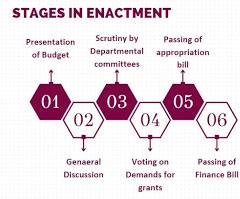
II. Six Stages of Budget Enactment
The budget enactment process involves six stages:
- Presentation of Budget: The Finance Minister presents the Budget Speech in the Lok Sabha and lays documents in the Rajya Sabha.
- General Discussion: A broad debate on policy in both Houses without voting.
- Scrutiny by Departmental Committees: Standing Committees examine Demands for Grants.
- Voting on Demands for Grants: Exclusively in the Lok Sabha, where Cut Motions can be moved.
- Passing of Appropriation Bill: Authorises withdrawal of funds from the CFI.
- Passing of Finance Bill: Legalises taxation proposals and must be enacted within 75 days.
III. Parliamentary Tools of Control
Parliament uses several tools to control the budget:
- Cut Motions: Used in Lok Sabha to oppose demands. These include Policy Cuts (reducing demand to ₹1), Economy Cuts (reducing by a specified amount), and Token Cuts (reducing by ₹100 to air grievances).
- Guillotine: On the last day of voting, the Speaker puts all pending demands to vote.
- Vote on Account (Art. 116): An advance grant to the government for short-term expenditure until the budget is passed.
IV. Types of Expenditure
Expenditure is categorised as:
- Charged Expenditure: Non-votable but discussable, covering items like salaries of the President and judges.
- Voted Expenditure: Presented as Demands for Grants to the Lok Sabha.
V. Other Grants
Other grants include:
- Supplementary Grant: For insufficient sanctioned amounts.
- Excess Grant: For expenditure beyond the granted amount, requiring Public Accounts Committee approval.
- Vote of Credit: A grant for unforeseen large expenditures.
AI responses may include mistakes. Information may vary depending on location or individual circumstances. Learn more


14 sites
- Budgetary Process in India: Components, Stages & More11 Aug 2025 — TABLE OF CONTENTS * What is Budget? * Components of Union Budget. * Stages in Enactment of Budget. Presentation of Budget. Budget …
NEXT IAS
- Union Budget 2026: Date, Structure, Process, Highlights & …1 Feb 2026 — Union Budget 2026: Date, Structure, Process, Highlights & Download PDF * What is the Union Budget? * A Brief History of Budget in …
Vision IAS
- The Budget in Parliament (Article 112) – Clarity Desk Hub IAS27 Dec 2025 — Meaning and Constitutional Basis. The Constitution never uses the word “Budget.” It calls it the Annual Financial Statement (AFS) …
claritydeskhub.com
Show all
add 10 question with answer with penemonics
Here are 10 high-yield questions on the
Parliamentary Budgetary Process with answers and mnemonics designed for 2026 exam readiness.
10 Questions & Answers on the Budget
Q1: Which Article of the Constitution deals with the Annual Financial Statement?
A: Article 112.
- Mnemonic: Think of 1-1-2 as the “Financial Emergency Number” for the nation’s accounts.
Q2: Which stage of the budget is exclusive to the Lok Sabha?
A: Voting on Demands for Grants.
- Mnemonic: “V-L” — Voting is Limited to Lok Sabha.
Q3: What happens if the ‘Motion of Thanks’ or the ‘Budget’ is defeated in the Lok Sabha?
A: The Council of Ministers must resign as it signifies a loss of majority.
- Mnemonic: “D-D” — Defeat equals Dismissal of the Government.
Q4: Which motion is used to reduce a demand for grant to ₹1?
A: Policy Cut Motion.
- Mnemonic: “P-1” — Policy is the 1st (and harshest) disapproval.
Q5: What is the purpose of a ‘Vote on Account’?
A: To provide the government with funds for a short period (usually 2 months) until the full budget is passed.
- Mnemonic: “V-A-C” — Vote Ahead of Completion.
Q6: What is the ‘Guillotine’ in the context of the budget?
A: It is the process where the Speaker puts all remaining undiscussed demands for grants to vote on the last day.
- Mnemonic: “G-G” — Guillotine Groups all items for one final cut.
Q7: Which bill legalises the taxation proposals of the government?
A: The Finance Bill.
- Mnemonic: “F-T” — Finance Bill handles Taxes (Income).
Q8: Can the Rajya Sabha vote on the Demands for Grants?
A: No, it can only discuss them.
- Mnemonic: “R-R” — Rajya Sabha can only Review.
Q9: What is a ‘Token Cut’ motion?
A: A motion to reduce the demand by ₹100 to vent a specific grievance.
- Mnemonic: “T-100” — A Token is worth 100.
Q10: Who certifies a bill as a Money Bill (and thus a Finance Bill)?
A: The Speaker of the Lok Sabha.
- Mnemonic: “S-S” — Speaker is the Sole authority.
Master Mnemonic for Budget Stages
To remember the 6 stages of the budget in order:
“P-G-S-V-A-F”
- Presentation
- General Discussion
- Scrutiny by Committees
- Voting on Demands
- Appropriation Bill (Withdrawal)
- Finance Bill (Taxation)
Mnemonic Sentence: Please Give Some Valuable Account Facts.
Ready to create a quiz?
Use Canvas to test your knowledge with a custom quiz
Get started
polity laxmikant president chapter summary with 25 question with answer and pnemonics for retention
This summary covers
Chapter 17 (The President) of M. Laxmikanth’s Indian Polity, focusing on the 2026 examination requirements.
I. Qualifications, Election, and Tenure
- Article 52-78: Deals with the Union Executive (President, VP, PM, Council of Ministers, and Attorney General).
- Qualifications: Must be a citizen, age 35+, qualified for Lok Sabha membership, and hold no office of profit.
- Election (Art. 54): Indirect election via an Electoral College.
- Included: Elected members of LS, RS, State Legislative Assemblies, and Delhi/Puducherry Assemblies.
- Excluded: All nominated members and State Legislative Councils.
- Mnemonic for Election: “E-E” — Only Elected members enter the Electoral College.
II. Impeachment and Vacancy
- Impeachment (Art. 61): Only on grounds of “Violation of the Constitution” (not defined in the Constitution).
- Initiated by 1/4th members of either House; passed by 2/3rd total strength of each House.
- Nominated members participate in impeachment (even though they don’t vote in elections).
- Mnemonic for Impeachment: “V-I-P” — Violation Is the Prerequisite.
III. Powers of the President
- Executive: All executive actions of GoI are taken in his name. Appoints PM, Ministers, CAG, CEC, Governors, etc.
- Legislative: Summons/prorogues Parliament, dissolves Lok Sabha, and addresses the first session each year.
- Veto Powers (Art. 111):
- Absolute: Withholding assent.
- Suspensive: Returning for reconsideration (cannot be used for Money Bills).
- Pocket: Taking no action.
- Ordinance Power (Art. 123): Promulgated when Parliament is not in session; must be approved within 6 weeks of reassembly.
- Pardoning Power (Art. 72): Includes Pardon, Commutation, Remission, Respite, and Reprieve.
25 Rapid-Fire Q&A with Mnemonics
| # | Question | Answer | Mnemonic/Logic |
|---|---|---|---|
| 1 | Who is the formal head of the state? | President | “N-H” (Nominal Head) |
| 2 | Min age for President? | 35 Years | “P-35” |
| 3 | Can nominated members vote in the election? | No | Only Elected members. |
| 4 | Can nominated members vote in impeachment? | Yes | They help remove him. |
| 5 | Article for Impeachment? | Art. 61 | “6-1” = One way out. |
| 6 | Grounds for impeachment? | Violation of Constitution | Only one reason. |
| 7 | Who administers the Oath? | Chief Justice of India | “P-CJI” connection. |
| 8 | To whom does the President resign? | Vice-President | Peer-to-peer exchange. |
| 9 | Article for Pardoning power? | Art. 72 | “7-2” = Mercy. |
| 10 | Can he return a Money Bill? | No | “M-N” (Money-No) |
| 11 | Max life of an Ordinance? | 6 months & 6 weeks | “6-6 Rule” |
| 12 | Pocket Veto used by? | Giani Zail Singh (1986) | Post Office Bill case. |
| 13 | Does he have “Qualified Veto”? | No | Only US President has it. |
| 14 | Article for Ordinance? | Art. 123 | “1-2-3-Go!” |
| 15 | Number of proposers required? | 50 Proposers | “50-50” (50 Secoders) |
| 16 | Security deposit amount? | ₹15,000 | In RBI. |
| 17 | Who decides election disputes? | Supreme Court | “E-S” (Election-SC) |
| 18 | Is the President part of Parliament? | Yes (Art. 79) | But not a member. |
| 19 | Term of office? | 5 Years | Standard term. |
| 20 | How many times can he be re-elected? | Any number of times | No limit in India. |
| 21 | Quorum for Impeachment motion? | 1/4th for notice | To start the fire. |
| 22 | Majority for Impeachment? | 2/3rd Total Strength | Toughest majority. |
| 23 | Can he pardon a Court Martial? | Yes | Unique to President. |
| 24 | Does he have discretionary power? | Situational only | Not constitutional. |
| 25 | Who appoints the PM? | President | “P-P” (President-PM) |
Mnemonics for Pardoning Power (Art 72)
Use the word “P-C-R-R-R”:
- Pardon: Completely absorbs the crime and sentence.
- Commutation: Substituting a lighter form (e.g., Death to Life).
- Remission: Reducing the period (e.g., 2 years to 1 year) without changing character.
- Respite: Lesser sentence due to special facts (e.g., pregnancy).
- Reprieve: Temporary stay of execution.
Actionable Step: Review the Official Constitutional Articles to see the exact phrasing of Article 72 and 123.
Would you like to compare the President’s Veto powers with the Governor’s next, or move to the Vice-President chapter?
26 sites
- UPSC CAPF 2026: The Ultimate Guide to Becoming an Assistant Commandant (AC)24 Sept 2025 — This guide focuses exclusively on the 2026 examination, providing you with targeted information to prepare effectively for this es…
Filo
- Tips and Tricks to Remember the Constitution of India in Under 10 minutesThree union executives There are mainly three union executives in the country, including the President, Vice President, and the Un…
Unacademy
- EXECUTIVE POWERSPart V of the Indian constitution deals with matters of union executive. Part V of Indian constitution comprises article 52 to 78 …
Show all
articles related to the president with pnemonics and 50 questions on articles related to president with pnemonics
Here is the comprehensive breakdown of Articles 52 to 62 (The President) from
Laxmikanth’s Indian Polity, along with the requested mnemonics and active-recall questions.
The Master Mnemonic: “P-E-E-T-R-Q-O-I-V”
To remember the sequence of Articles 52–62:
- 52: P – President of India
- 53: E – Executive Power
- 54: E – Election
- 55: T – Tanner (Manner) of Election
- 56: T – Term of Office
- 57: R – Re-election eligibility
- 58: Q – Qualifications
- 59: C – Conditions of Office
- 60: O – Oath or Affirmation
- 61: I – Impeachment Procedure
- 62: V – Vacancy filling
50 High-Yield Questions on President’s Articles
Articles 52-61 (The Basics)
- Q: Which Article says there shall be a President of India? A: 52 (President).
- Q: Which Article vests the Executive power of the Union in the President? A: 53 (Executive).
- Q: Which Article defines the Electoral College? A: 54 (Election).
- Q: Which Article explains the Proportional Representation system? A: 55 (Manner/Tanner).
- Q: Which Article states the President’s term is 5 years? A: 56 (Term).
- Q: Which Article allows a President to be re-elected? A: 57 (Re-election).
- Q: Which Article lists the age requirement (35 years)? A: 58 (Qualification).
- Q: Which Article prohibits the President from holding an Office of Profit? A: 59 (Conditions).
- Q: Which Article deals with the Oath by the CJI? A: 60 (Oath).
- Q: Which Article details the procedure for removal? A: 61 (Impeachment).
Articles 72-111 (Powers & Veto)
- Q: Which Article gives the power to grant Pardons? A: 72 (Mnemonic: 7-2 = “Saath do” / Support/Mercy).
- Q: Which Article says the PM must advise the President? A: 74.
- Q: Which Article empowers the President to appoint the PM? A: 75.
- Q: Which Article deals with the Attorney General’s appointment? A: 76.
- Q: Which Article defines the President as part of Parliament? A: 79.
- Q: Which Article allows the President to address Parliament? A: 86.
- Q: Which Article covers the Special Address at the start of a session? A: 87.
- Q: Which Article gives power for a Joint Sitting? A: 108 (Mnemonic: 108 is an emergency number).
- Q: Which Article deals with the President’s Assent to Bills? A: 111 (Mnemonic: 1-1-1 = 3 choices: Yes, No, or Return).
- Q: Which Article covers the Annual Financial Statement? A: 112 (Mnemonic: 1-1-2 = Financial emergency info).
Articles 123-143 (Judicial & Ordinance)
- Q: Which Article allows the President to promulgate Ordinances? A: 123 (Mnemonic: 1-2-3-Go! – Immediate law).
- Q: Which Article allows the President to seek advice from the Supreme Court? A: 143 (Mnemonic: 1-4-3 = “I Love You” – A friendly consultation).
- Q: Which Article empowers the President to appoint SC Judges? A: 124.
- Q: Which Article covers the appointment of the CAG? A: 148.
- Q: Which Article allows for the appointment of State Governors? A: 155.
Articles 352-360 (Emergency Powers)
- Q: Article for National Emergency? A: 352 (Mnemonic: 352 = 3+5+2=10/War).
- Q: Article for President’s Rule? A: 356 (Mnemonic: 352+4).
- Q: Article for Financial Emergency? A: 360 (Mnemonic: 356+4).
- Q: Which Article gives immunity to the President from court proceedings? A: 361.
- Q: Which Article allows the President to suspend Fundamental Rights during an emergency? A: 359.
Technicalities & Nuances
- Q: Under which Article does the President appoint the Finance Commission? A: 280.
- Q: Which Article mentions the Inter-State Council? A: 263.
- Q: Article for the appointment of the SC/ST Commission? A: 338/338A.
- Q: Which Article governs the administration of Scheduled Areas? A: 244.
- Q: Which Article deals with the Language Commission? A: 344.
- Q: Which Article says the President acts on the aid and advice of the CoM? A: 74(1).
- Q: Is Article 61 the only way a President leaves? A: No, Art 56 (Resignation) also applies.
- Q: Which Article says the Vice-President acts as President? A: 65.
- Q: Which Article deals with disputes in Presidential elections? A: 71 (Mnemonic: 7-1 = “Settle One” dispute at SC).
- Q: Which Article gives the President power over UTs? A: 239.
- Q: Article for the disqualification of MPs (Decision by President)? A: 103.
- Q: Which Article requires the President’s recommendation for a Money Bill? A: 117(1).
- Q: Which Article governs the “Contingency Fund” under the President? A: 267.
- Q: Which Article deals with the transfer of High Court Judges? A: 222.
- Q: Which Article grants the President power to declare an area “Scheduled”? A: 5th Schedule (Art 244).
- Q: Which Article allows the President to refer a bill to the SC? A: 143.
- Q: Which Article specifies the “Value of Vote” formula? A: 55.
- Q: Article for the 14-day notice for Impeachment? A: 61.
- Q: Which Article says the President’s power extends to the whole of India? A: 53.
- Q: Which Article handles the appointment of the Election Commission? A: 324.
Advanced Retention Mnemonic for Emergency (352-360)
“N-S-F” (National – State – Financial)
- 352 (N)
- 356 (S)
- 360 (F)
Add +4 each time to move from National to State to Financial.
Would you like to move on to the Prime Minister and Council of Ministers next, or should we tackle the Emergency Provisions in depth?
powers of president of india summary with 10 question with answer
The powers of the President of India, as detailed in
M. Laxmikanth’s Indian Polity, are extensive but primarily nominal, as they are exercised on the aid and advice of the Council of Ministers (Art. 74).
Summary of Presidential Powers
- Executive Powers: All executive actions of the GOI are taken in his name. He appoints the PM, Union Ministers, Attorney General, CAG, CEC, and Governors. He can seek information from the PM regarding administration.
- Legislative Powers: He is an integral part of Parliament. He summons/prorogues sessions, dissolves the Lok Sabha, and addresses the first session each year. He nominates 12 members to the Rajya Sabha.
- Veto Powers (Art. 111):
- Absolute: Withholds assent (Bill dies).
- Suspensive: Returns the bill for reconsideration (except Money Bills).
- Pocket: Takes no action (Bill stays pending indefinitely).
- Financial Powers: No Money Bill can be introduced without his recommendation. He constitutes the Finance Commission every 5 years and manages the Contingency Fund of India.
- Judicial Powers: Appoints the Chief Justice and judges of the Supreme Court and High Courts. He can seek advice from the SC (Art. 143).
- Pardoning Power (Art. 72): Can grant Pardons, Commutations, Remissions, Respites, or Reprieves for sentences (including death sentences and court-martials).
- Diplomatic & Military Powers: International treaties are negotiated in his name. He is the Supreme Commander of the Defence Forces.
- Emergency Powers: Can declare National Emergency (Art. 352), President’s Rule (Art. 356), and Financial Emergency (Art. 360).
- Ordinance Power (Art. 123): Can promulgate laws when Parliament is not in session (max life: 6 months and 6 weeks).
10 Questions & Answers for Revision
| # | Question | Answer | Mnemonic/Logic |
|---|---|---|---|
| 1 | Which power allows the President to enact laws during a recess? | Ordinance Power (Art. 123) | 1-2-3-Go! (Instant law) |
| 2 | Can the President return a Money Bill? | No | M-N (Money-No) |
| 3 | Who is the Supreme Commander of the Defence Forces? | The President | “S-C” (Supreme Commander) |
| 4 | Under which Article does the President seek advice from the SC? | Article 143 | 1-4-3 (I-Love-You / Friendly advice) |
| 5 | Which veto did Zail Singh use in 1986? | Pocket Veto | “P-P” (Pocketed the Post Office Bill) |
| 6 | How many members does he nominate to the Rajya Sabha? | 12 | Expertise in L-A-S-S |
| 7 | Which Article grants the President pardoning powers? | Article 72 | “Saath do” (Give support/mercy) |
| 8 | Who appoints the Chairman of the Finance Commission? | The President | “F-P” (Finance-President) |
| 9 | Can the President pardon a Death Sentence? | Yes | Ultimate mercy power. |
| 10 | To whom does the President address his resignation? | Vice-President | “P-VP” (Direct handover) |
Mnemonics for Retention
- Pardoning Types (P-C-R-R-R):
- Pardon (Complete)
- Commutation (Substitute lighter form)
- Remission (Reduce time)
- Respite (Special facts like pregnancy)
- Reprieve (Temporary stay)
- Nominations (L-A-S-S):
- Literature, Art, Science, Social Service.
Would you like to see a comparison of the President’s Veto powers versus the US President’s Qualified Veto?
yes
In Indian Polity, the
Veto Power of the President of India is often compared with that of the US President to understand the degree of executive control over the legislature.
President of India vs. US President: Veto Comparison
| Veto Type | President of India | US President |
|---|---|---|
| Absolute Veto | Available. Can withhold assent to bills (usually for Private Member bills). | Available. President can refuse to sign a bill. |
| Suspensive Veto | Available. Can return a bill for reconsideration; if passed again by Simple Majority, the President must sign. | Not Available in this form. Instead, they use a “Qualified Veto” (see below). |
| Qualified Veto | Not Available. Indian President cannot be overridden by a higher majority. | Available. Congress can override the veto only by a Higher (2/3rd) Majority in both houses. |
| Pocket Veto | Available & Stronger. Can keep a bill on their desk indefinitely (Constitution specifies no time limit). | Limited. Must act within 10 days. If Congress adjourns within those 10 days, the bill dies (the “Pocket”). |
Key Retention Mnemonics
- Indian “Pocket” is Deeper: Because the Indian Constitution says nothing about the timeframe to sign, our President’s pocket has “no bottom,” whereas the US President’s pocket has a “10-day limit.”
- The “Q” Rule: Qualified Veto is Quite absent in India.
10 Comparison Q&A
- Q: Does the Indian President possess a “Qualified Veto”?
A: No, only the US President has it. - Q: What is the time limit for the Indian President to return a bill?
A: No time limit is prescribed (Pocket Veto). - Q: Can the Indian President return a Money Bill?
A: No, they must give or withhold assent. - Q: What majority is needed in India to override a Suspensive Veto?
A: A Simple Majority. - Q: What majority is needed in the US to override a veto?
A: A Special (2/3rd) Majority. - Q: Who used the Pocket Veto in India for the first time?
A: President Giani Zail Singh (Post Office Bill, 1986). - Q: In which case is the Indian President’s veto power stronger?
A: The Pocket Veto, due to the lack of a 10-day rule. - Q: Can the President use Absolute Veto on a Government Bill?
A: Usually only if the Cabinet resigns and the new Cabinet advises against it. - Q: Does the 24th Amendment Act, 1971 affect vetoes?
A: Yes, it made it obligatory for the President to give assent to Constitutional Amendment Bills. - Q: Can the President use a Veto for a State Bill?
A: Yes, via the Governor (Art. 201), and they can withhold assent indefinitely.
Would you like to analyze the Vice-President’s election and removal next, or go back to Parliamentary Committees?
AI responses may include mistakes. For financial advice, consult a professional. Learn more
before moving ahead kindly explain pardoning power with pnemonics
In
M. Laxmikanth’s Indian Polity, the Pardoning Power of the President is enshrined in Article 72. It is a sovereign power intended to correct judicial errors and provide relief from sentences that are unduly harsh.
The Master Mnemonic: “P-C-R-R-R”
To remember the five distinct types of pardoning powers, use the acronym P-C-R-R-R (pronounced like a “Purr”).
1. P – Pardon
- Meaning: It completely removes both the sentence and the conviction.
- Result: The convict is released as if they never committed the crime.
- Mnemonic Logic: Pardon = Pure (The record becomes pure again).
2. C – Commutation
- Meaning: Substituting one form of punishment for a lighter form.
- Example: Changing a Death Sentence to Rigorous Imprisonment.
- Mnemonic Logic: Commutation = Change (Changing the character of the punishment).
3. R – Remission
- Meaning: Reducing the period of the sentence without changing its character.
- Example: Reducing a sentence from 2 years of rigorous imprisonment to 1 year of rigorous imprisonment.
- Mnemonic Logic: Remission = Reduce (Reducing time, but the work remains the same).
4. R – Respite
- Meaning: Awarding a lesser sentence than originally awarded due to some special fact.
- Example: Physical disability or the pregnancy of a woman convict.
- Mnemonic Logic: Respite = Rest (Given when the convict needs “rest” due to health/pregnancy).
5. R – Reprieve
- Meaning: It stays the execution of a sentence (especially death) for a temporary period.
- Purpose: To enable the convict to seek a pardon or commutation.
- Mnemonic Logic: Reprieve = Relief (A temporary “Relief” or “Pause” button).
Key Rules & Differences (High-Yield for 2026 Exams)
- Executive Nature: This is an executive power, not a judicial one. The President does not sit as a court of appeal.
- Oral Hearing: The convict has no right to an oral hearing by the President.
- Advice: The President must act on the advice of the Union Cabinet (Art 74).
- President vs. Governor (Crucial Difference):
- Death Sentence: Only the President can pardon a death sentence. A Governor can only suspend, remit, or commute it.
- Court Martial: Only the President can pardon sentences inflicted by a Military Court (Court Martial).
Quick Quiz (Active Recall)
- Q: Which device changes the nature of the punishment? A: Commutation.
- Q: Which device reduces the duration but keeps the nature same? A: Remission.
- Q: Under which Article does this power lie? A: Article 72.
Would you like to see the Vice-President’s chapter summary now, or should we move into Parliamentary Committees?
AI responses may include mistakes. For legal advice, consult a professional. Learn more
yes
As per
M. Laxmikanth’s Indian Polity, the Vice-President (VP) holds the second-highest constitutional office in India, modeled after the American Vice-President.
I. Vice-President: Summary
- Articles 63–73: Deal with the office, election, and removal of the VP.
- Election: Indirectly elected by an Electoral College consisting of both elected and nominated members of both Houses of Parliament. Note: State Legislative Assemblies are not part of this college.
- Qualifications: Citizen of India, age 35+, and qualified for election as a member of the Rajya Sabha.
- Two-Fold Role:
- Ex-officio Chairman of Rajya Sabha: Presides over the House; has a casting vote but cannot vote normally as they are not a member.
- Acting President: When the Presidency is vacant (death, resignation, removal), the VP acts as President for a maximum of 6 months.
- Removal: Can be removed by a resolution passed by the Rajya Sabha with an effective majority (majority of then members) and agreed to by the Lok Sabha. A 14-day notice is mandatory.
II. 25 High-Yield Questions on Vice-President
| # | Question | Answer | Mnemonic/Logic |
|---|---|---|---|
| 1 | Which Article mandates there shall be a VP? | Article 63 | 6-3 = “Six-three, VP’s for me” |
| 2 | Who is the ex-officio Chairman of Rajya Sabha? | Vice-President | “VP-RS” connection |
| 3 | Minimum age for Vice-President? | 35 years | Same as President (P-35) |
| 4 | Can nominated MPs vote in VP election? | Yes | “All-In” (Both Houses, All Members) |
| 5 | Do State Assembly members vote for VP? | No | Only Parliament members |
| 6 | To whom does the VP submit their resignation? | President | Peer-to-peer exchange |
| 7 | Who administers the oath to the VP? | President | “P-O” (President’s Oath) |
| 8 | Can the VP vote on normal resolutions in RS? | No | Only a Casting Vote in ties |
| 9 | Max period the VP can act as President? | 6 Months | Same as session gap |
| 10 | Whose rank is 2nd in the Warrant of Precedence? | Vice-President | Second highest post |
| 11 | Who decides disputes in VP elections? | Supreme Court | “S-C” final arbiter |
| 12 | Is a formal impeachment needed for VP? | No | Only a House resolution |
| 13 | Article for VP acting as President? | Article 65 | “6-5” (VP to President) |
| 14 | Can the VP be re-elected? | Any number of times | No constitutional limit |
| 15 | Does the VP receive a salary for that post? | No | Salary is for being RS Chairman |
| 16 | What majority is needed in RS for removal? | Effective Majority | Majority of current members |
| 17 | What majority is needed in LS for removal? | Simple Majority | Just “agree” to RS |
| 18 | Can a VP continue beyond 5 years? | Yes | Until a successor joins |
| 19 | Article for VP’s Oath? | Article 69 | “6-9” Oath line |
| 20 | Is the VP a member of the Rajya Sabha? | No | Not a member of either House |
| 21 | Who was the first VP of India? | S. Radhakrishnan | Served 2 terms |
| 22 | Can the VP preside over RS while being removed? | No | Must step down during debate |
| 23 | Does the VP’s election use EVMs? | No | Secret paper ballot used |
| 24 | Is a political “whip” binding in VP election? | No | MPs vote by conscience |
| 25 | Can the VP act as President during illness? | Yes | Discharges duties temporarily |
III. Mnemonics for Retention
- Election College (A-P-M): All Parliament Members (Both Elected + Nominated).
- Qualifications (C-35-RS): Citizen, 35 years old, Rajya Sabha eligibility.
- Removal Steps (R-L-14): Rajya Sabha initiates -> Lok Sabha agrees -> 14 days notice.
Proactive Follow-up: Would you like to finish the set with the Parliamentary Committees (PAC, Estimates, etc.) or shall we start the Judiciary (Supreme Court) chapter?
AI responses may include mistakes. For financial advice, consult a professional. Learn more

11 sites
- Vice President of India, Articles, Election, UPSC Notes3 Jan 2026 — The Vice-President is accorded a rank next to the President in the official warrant of precedence. This office is modeled on the l…
Vajiram & Ravi
- Vice-President of India – Elections, Qualifications – BYJU’SThe functions of Vice-President are two-fold: * He acts as the ex-officio Chairman of Rajya Sabha. In this capacity, his powers an…
BYJU’S
- SSC Notes on The Vice President – UnacademyThe Vice President. The Vice-President of India is mentioned in Chapter I (Executive) of Part V of the Indian Constitution, which …
Unacademy
Show all
all important articles related to the vice president with 25 question and answer with hint to remember
In
M. Laxmikanth’s Indian Polity, the Vice-President’s office is covered primarily under Articles 63 to 71.
I. Important Articles Table
| Article | Subject Matter | Mnemonic / Retention Hint |
|---|---|---|
| 63 | The Vice-President of India | “63 – VP to be”: Starts the office. |
| 64 | Ex-officio Chairman of Rajya Sabha | “64 – Chair on the floor”: Links VP to RS. |
| 65 | VP to act as President during vacancy | “65 – Vice to Rise”: Steps up to the top job. |
| 66 | Election of Vice-President | “66 – Double Six/Double House”: Both LS & RS vote. |
| 67 | Term of office (5 years) | “67 – Stay in Heaven”: Duration of stay. |
| 68 | Time of holding election to fill vacancy | “68 – Fill the gate”: Timing for new elections. |
| 69 | Oath or affirmation | “69 – Divine Line”: The swearing-in. |
| 70 | Discharge of President’s functions in contingencies | “70 – Extra Duty”: Unforeseen situations. |
| 71 | Matters relating to Election (Disputes) | “71 – Done by One (SC)”: SC settles disputes. |
II. 25 High-Yield Questions & Answers
| # | Question | Answer | Hint to Remember |
|---|---|---|---|
| 1 | Which Article says “There shall be a VP”? | 63 | First Article of the chapter. |
| 2 | Article for VP acting as RS Chairman? | 64 | 6-4: He sits “for” the House. |
| 3 | Which Article deals with VP election? | 66 | 66: Two Houses, one election. |
| 4 | Article for the VP’s Oath? | 69 | 69: Last digit ‘9’ looks like a ‘g’ (God). |
| 5 | Article for Election Disputes? | 71 | 71: ‘1’ looks like a gavel (Judiciary/SC). |
| 6 | Who settles VP election disputes? | Supreme Court | S-C (Supreme/Settles). |
| 7 | Can the VP vote in the first instance in RS? | No | He is a guest (Chairman), not a member. |
| 8 | To whom does the VP resign? | President | Top to Top: Number 2 to Number 1. |
| 9 | Article for Term of Office? | 67 | 6-7: Lucky number 7 for a long term. |
| 10 | Is the VP a member of Parliament? | No | He is a Presiding Officer, not a member. |
| 11 | Who administers the VP’s oath? | President | The “Boss” swears in the “Deputy”. |
| 12 | Article for VP acting as President? | 65 | 6-5: VP is the “backup” 5. |
| 13 | Min age for VP election? | 35 | Same as President (P-35). |
| 14 | Does the VP election include MLAs? | No | VP = Very Parliamentary (Only MP). |
| 15 | What majority is needed in RS for removal? | Effective | Effective = Exiting those gone. |
| 16 | What majority is needed in LS for removal? | Simple | LS just needs to “Agree”. |
| 17 | Can nominated MPs vote for VP? | Yes | All-In: Everyone in Parliament. |
| 18 | Article for vacancy timing? | 68 | 6-8: “Don’t be late” for the date. |
| 19 | Who was the first VP of India? | S. Radhakrishnan | The Teacher-VP. |
| 20 | Does the VP get a salary as VP? | No | Paid for being RS Chairman. |
| 21 | Can the VP be re-elected? | Yes | Infinite times (unlike USA). |
| 22 | Notice period for VP removal? | 14 Days | Fortnight Rule. |
| 23 | Can VP preside while being removed? | No | He is “On the Dock”. |
| 24 | Does the VP have a “casting vote”? | Yes | To break a tie (C-C: Casting-Chairman). |
| 25 | Article for Parliament handling contingencies? | 70 | 70: The “Empty Space” filler. |
III. Summary Mnemonic: “E-C-A-E-T” (The VP Office)
- Election (66)
- Chairman (64)
- Acting President (65)
- Eligibility (66)
- Term (67)
Proactive Follow-up: Shall we now proceed to the Prime Minister and Council of Ministers to see how the “Real Executive” works, or finish Parliamentary Committees?
AI responses may include mistakes. Information may vary depending on location or individual circumstances. Learn more

10 sites
- [Solved] Article 63 of the Indian Constitution refers to – Testbook24 Oct 2025 — Article 63 of the Indian Constitution states that “There shall be a vice president of India.” – Article 63 of the Indian C…
Testbook
- PracticeIntroduction: Article 63 of the Constitution of India provides for a Vice-President, who under Article 64 is the ex-officio Chairm…
Drishti IAS
- The Constitutional provisions related to the Vice-President of India …30 Jan 2026 — Article 65: Outlines the Vice-President’s role in acting as President or discharging presidential functions during vacancies or ab…
Show all
yes
Moving to the
Prime Minister (PM) and Council of Ministers (CoM)—the “Real Executive” of India as per M. Laxmikanth’s Indian Polity.
I. Prime Minister & CoM: Summary
- Real Executive (De Facto): Unlike the President (Nominal), the PM is the actual head of the government.
- Appointment (Art 75): The PM is appointed by the President. By convention, the President must appoint the leader of the majority party in the Lok Sabha.
- Responsibility: The Council of Ministers is collectively responsible to the Lok Sabha (Art 75). If a No-Confidence Motion passes, the entire ministry resigns.
- Size (91st Amendment): The total number of ministers (including the PM) cannot exceed 15% of the total strength of the Lok Sabha.
II. Important Articles & Mnemonics
| Article | Subject Matter | Mnemonic / Hint |
|---|---|---|
| 74 | CoM to aid and advise President | “7-4: Core” – The core advice for the President. |
| 75 | Appointment, Salaries, Responsibility | “7-5: Alive” – The PM brings the govt to life. |
| 77 | Conduct of Business of GoI | “Double 7: Order” – How the Govt acts. |
| 78 | PM’s duty to inform President | “7-8: Communicate” – PM as the bridge. |
III. 25 High-Yield Questions & Answers
| # | Question | Answer | Hint/Mnemonic |
|---|---|---|---|
| 1 | Is the PM’s office mentioned in the Constitution? | Yes (Art 74/75) | Constitutional post. |
| 2 | Who is the ‘De Facto’ head? | Prime Minister | D-F: Do-er of Facts. |
| 3 | Min age for PM? | 25 (if LS) / 30 (if RS) | Depends on the House. |
| 4 | Can a non-MP be PM? | Yes, for 6 months | Must get elected within 180 days. |
| 5 | Who advises President on Ministers? | Prime Minister | President cannot choose alone. |
| 6 | What is ‘Collective Responsibility’? | Sink or Swim together | Entire boat stays or drowns. |
| 7 | To which House is CoM responsible? | Lok Sabha only | L-S: Linked Solely. |
| 8 | Can a Minister from RS speak in LS? | Yes | Can speak in both, vote in one. |
| 9 | Where does a Minister vote? | In their own House | V-O: Vote Only in home. |
| 10 | Max size of CoM? | 15% of Lok Sabha | 1-5 Rule (91st Amendment). |
| 11 | Who is the “Keystone of Cabinet Arch”? | Prime Minister | Holds the whole structure. |
| 12 | Can the President dismiss a Minister? | Only on PM’s advice | P-A: PM Authorizes. |
| 13 | Who is the bridge between CoM & President? | Prime Minister | Art 78 link. |
| 14 | Article for Conduct of Business? | 77 | 7-7: Step-by-step business. |
| 15 | Does ‘Council’ include ‘Cabinet’? | Yes | Council is the bigger circle. |
| 16 | Is ‘Cabinet’ mentioned in original Const? | No | Added by 44th Amendment (Art 352). |
| 17 | Who chairs the NITI Aayog? | Prime Minister | Ex-officio head. |
| 18 | Can PM dissolve Lok Sabha? | No, can only advise President | A-D: Advise Dissolution. |
| 19 | Who presides over Cabinet meetings? | Prime Minister | P-C: PM Chairs. |
| 20 | Is the PM’s salary fixed by Constitution? | No, by Parliament | MPs decide their boss’s pay. |
| 21 | If PM resigns, does CoM dissolve? | Yes | H-D: Head Dies, body dies. |
| 22 | Who is the Chief Spokesman of the Govt? | Prime Minister | The face of the nation. |
| 23 | Is there a legal responsibility for Ministers? | No | In India, only political responsibility. |
| 24 | Article for ‘Aid and Advice’? | 74 | The root of all power. |
| 25 | Who decides the portfolios? | Prime Minister | He distributes the work. |
IV. Retention Mnemonic: “B-R-I-D-G-E” (The PM’s Role)
- B – Bridge (Between President & CoM).
- R – Real Executive.
- I – Informs President (Art 78).
- D – Distributes Portfolios.
- G – Guides CoM.
- E – Elected Leader (of LS Majority).
Proactive Follow-up: Shall we tackle the Parliamentary Committees (PAC, Estimates, etc.) now to see how Parliament audits this Executive, or move to the Supreme Court?
AI responses may include mistakes. For financial advice, consult a professional. Learn more
council of minister first
In
M. Laxmikanth’s Indian Polity, the Council of Ministers (CoM) is the real executive authority. While the President is the nominal head, the CoM, led by the Prime Minister, wields the actual power.
I. Council of Ministers: Summary
- Constitutional Status (Arts 74 & 75):
- Art 74: There shall be a CoM to aid and advise the President. The advice is binding (after one reconsideration).
- Art 75: Ministers are appointed by the President on the PM’s advice. They hold office during the pleasure of the President.
- Collective Responsibility: This is the bedrock of parliamentary democracy. The CoM is collectively responsible to the Lok Sabha. If the House passes a no-confidence motion, all ministers (even those from Rajya Sabha) must resign.
- Individual Responsibility: Ministers are also individually responsible to the President (meaning the President can remove a minister, but only on the PM’s advice).
- Size Limit (91st Amendment, 2003): The total number of ministers, including the PM, cannot exceed 15% of the total strength of the Lok Sabha.
II. Classification of Ministers (The 3 Tiers)
- Cabinet Ministers: Senior leaders holding important portfolios (Home, Defence, Finance). They attend all Cabinet meetings.
- Ministers of State: Can be given independent charge or attached to Cabinet ministers. They attend meetings only when invited.
- Deputy Ministers: Attached to Cabinet or MoS to assist in administrative/parliamentary duties. They do not hold independent charge.
III. 25 High-Yield Questions & Answers
| # | Question | Answer | Hint/Mnemonic |
|---|---|---|---|
| 1 | Which Article deals with ‘Aid and Advice’? | 74 | 7-4: The “Support” Article. |
| 2 | To which House is the CoM responsible? | Lok Sabha | “L-S” (Lower house / Linked Solely). |
| 3 | Max limit of CoM members? | 15% of LS | “1-5 Rule” (91st Amendment). |
| 4 | Can a Minister be a member of neither House? | Yes, for 6 months | “6-month Grace”. |
| 5 | Who determines the salaries of Ministers? | Parliament | The law-makers set the pay. |
| 6 | Does the President have a choice in appointing ministers? | No | Only on PM’s Advice. |
| 7 | Is the term ‘Cabinet’ in the original Constitution? | No | Added by 44th Amendment (1978). |
| 8 | Where is ‘Cabinet’ defined? | Article 352 | Only in the Emergency Article. |
| 9 | What is ‘Kitchen Cabinet’? | Informal circle of PM | Private advisors (not constitutional). |
| 10 | Can a minister be sued for their advice? | No | Advice is confidential (Art 74). |
| 11 | Who administers the Oath? | President | “P-O” (President-Oath). |
| 12 | What is ‘Individual Responsibility’? | Removal by President | Only if the PM says so. |
| 13 | If a Minister disagrees with a Cabinet decision? | Must resign | “Speak as one or Leave”. |
| 14 | Can a Rajya Sabha MP be a Minister? | Yes | Indira Gandhi was the first. |
| 15 | Difference between CoM and Cabinet? | CoM is bigger | CoM = Body; Cabinet = Heart. |
| 16 | Does the CoM have a legal responsibility? | No | No counter-signing in India. |
| 17 | Who provides Secretarial assistance to CoM? | Cabinet Secretariat | Led by Cabinet Secretary. |
| 18 | Can a Minister vote in both Houses? | No | Vote only in Member House. |
| 19 | Can a Minister speak in both Houses? | Yes | Can participate everywhere. |
| 20 | Who is the head of the CoM? | Prime Minister | The captain of the ship. |
| 21 | When does the CoM dissolve automatically? | PM’s death/resignation | “Head gone, body gone”. |
| 22 | Article for Duties of PM (Information)? | 78 | “7-8: Communicate”. |
| 23 | Is the advice of CoM binding? | Yes | After 42nd & 44th Amendments. |
| 24 | Can the President return advice once? | Yes | 44th Amendment allowance. |
| 25 | Who handles the portfolios? | Prime Minister | He allocates all the “work”. |
IV. Retention Mnemonic: “S-I-N-K” (Collective Responsibility)
- S – Swim together.
- I – Inseparably linked to Lok Sabha.
- N – No-Confidence = Total Exit.
- K – Keep the secret (Cabinet secrecy).
Proactive Follow-up: Now that we’ve seen the “Real Executive,” shall we move to the Parliamentary Committees (Financial Control) or the Supreme Court (Judicial Control)?
AI responses may include mistakes. Information may vary depending on location or individual circumstances. Learn more
yes
Moving to
Parliamentary Committees (Financial Control) and the Supreme Court (Judicial Control) as per M. Laxmikanth’s Indian Polity.
I. Parliamentary Committees: Summary
Parliament is too large to handle all business. Committees provide detailed scrutiny.
- Public Accounts Committee (PAC): Scrutinises the CAG reports. It has 22 members (15 LS, 7 RS).
- Estimates Committee: Largest committee (30 members). All members are from Lok Sabha. It suggests “economies” in public expenditure.
- Committee on Public Undertakings: Reviews PSU performance. 22 members (15 LS, 7 RS).
- Standing Committees: 24 committees to supervise specific ministries.
II. Supreme Court of India: Summary
Established under Articles 124–147.
- Appointment: Judges are appointed by the President using the Collegium System.
- Removal: Only by a Special Majority in Parliament on grounds of “proved misbehaviour or incapacity.”
- Jurisdiction:
- Original: Disputes between Centre-State or State-State.
- Appellate: Final court of appeal for Civil/Criminal/Constitutional cases.
- Advisory (Art 143): President can seek SC advice.
III. 25 High-Yield Questions & Answers
| # | Question | Answer | Hint/Mnemonic |
|---|---|---|---|
| 1 | Which committee is called the ‘Twin Sister’ of PAC? | Estimates Committee | “P-E Twins”. |
| 2 | Which committee has NO Rajya Sabha members? | Estimates Committee | “E-L-O” (Estimates-LS-Only). |
| 3 | Who is the ‘Friend, Philosopher & Guide’ of PAC? | CAG | “C-P-F” connection. |
| 4 | Max members in PAC? | 22 (15 LS + 7 RS) | “15-7 Rule”. |
| 5 | Can a Minister join a financial committee? | No | “M-N” (Minister-No). |
| 6 | Who appoints the Chairman of PAC? | Speaker of LS | Traditionally from Opposition. |
| 7 | Total number of Standing Committees? | 24 | For the 24 hours of scrutiny. |
| 8 | Article for the Supreme Court? | 124 | “1-2-4: Door to Justice”. |
| 9 | Min age to be a Supreme Court Judge? | No minimum age | Only qualifications/experience. |
| 10 | Retirement age of SC Judge? | 65 years | “S-65” (SC-65). |
| 11 | Who administers the Oath to SC Judges? | President | Top Head for Top Judge. |
| 12 | Total number of SC Judges currently? | 34 (including CJI) | Fixed by Parliament. |
| 13 | Ground for removal of SC Judge? | Misbehaviour/Incapacity | “M-I” (M-proved I-ncapacity). |
| 14 | Article for ‘Court of Record’? | 129 | “Record at 129”. |
| 15 | Original Jurisdiction handles what? | Federal Disputes | “F-D” (First-Door). |
| 16 | Article for Advisory Jurisdiction? | 143 | “1-4-3: I-Love-You” (Friendly advice). |
| 17 | Who can increase the number of SC Judges? | Parliament | Law-makers expand the bench. |
| 18 | Collegium consists of whom? | CJI + 4 Senior-most Judges | “1+4” rule. |
| 19 | What is ‘Writ’ jurisdiction (Art 32)? | Protection of FRs | “Heart and Soul”. |
| 20 | Term of a Committee member? | 1 Year | “C-1” (Committee-1yr). |
| 21 | Which case established Collegium? | Second Judges Case (1993) | Shifted power to Judiciary. |
| 22 | Can SC review its own judgments? | Yes (Art 137) | “Self-Check”. |
| 23 | Who appoints the acting CJI? | President | Under Art 126. |
| 24 | Seat of the Supreme Court? | Delhi | But CJI can shift with President’s OK. |
| 25 | Is PAC advice binding on Govt? | No | Only advisory/recommendatory. |
IV. Retention Mnemonic: “P-A-C”
- P – Public scrutiny.
- A – Audit of CAG reports.
- C – Committee with Opposition head.
Proactive Follow-up: Do you want to see the Detailed Comparison Table of Writ Powers (Supreme Court vs High Court) or move to the State Government (Governor & CM)?
AI responses may include mistakes. For financial advice, consult a professional. Learn more
citizenship chapter summary with articles and act along with 50 question with answer and pnemonics for retenttion
This summary covers
Chapter 6 (Citizenship) of M. Laxmikanth’s Indian Polity, focusing on the Constitutional provisions and the Citizenship Act of 1955.
I. Constitutional Provisions (Articles 5–11)
Citizenship is in Part II of the Constitution. These articles only identified citizens at the commencement of the Constitution (Jan 26, 1950).
- Art 5: Citizenship at the commencement (Domicile).
- Art 6: Migrants from Pakistan.
- Art 7: Migrants to Pakistan but later Returned.
- Art 8: Persons of Indian Origin residing Abroad.
- Art 9: Voluntarily acquiring foreign citizenship (Loss of Indian citizenship).
- Art 10: Continuance of rights.
- Art 11: Parliament to regulate citizenship by law.
- Mnemonic: “D-P-R-A-V-P” (Domicile, Pakistan, Return, Abroad, Voluntarily, Parliament).
II. Citizenship Act, 1955: Acquisition & Loss
Acquisition (Mnemonic: B-R-A-N-D)
- Birth: Born in India.
- Registration: Married to Indian, or PIO residing for 7 years.
- Ascent/Descent: Born outside but parents are Indians.
- Naturalisation: Residing in India for 12 years (1+11).
- Dincorporation of Territory: If India acquires new land (e.g., Pondicherry).
Loss (Mnemonic: R-T-D)
- Renunciation: Voluntary giving up.
- Termination: By law when foreign citizenship is acquired.
- Deprivation: Compulsory termination by Govt (Fraud/Disloyalty).
III. 50 Rapid-Fire Q&A
| # | Question | Answer | Mnemonic/Hint |
|---|---|---|---|
| 1 | Which Part deals with Citizenship? | Part II | “C-2” |
| 2 | Which Article empowers Parliament? | Art 11 | “P-11” |
| 3 | Single vs Dual citizenship in India? | Single only | Unitary bias. |
| 4 | Can States provide citizenship? | No | Only Union. |
| 5 | Basis of Art 5? | Domicile | D-5 |
| 6 | Cut-off date for Pakistan migrants? | July 19, 1948 | “J-19” |
| 7 | Article for PIO living abroad? | Art 8 | “A-8” (Abroad) |
| 8 | Effect of taking foreign passport? | Automatic loss | Art 9. |
| 9 | Registration residence period? | 7 Years | “R-7” |
| 10 | Naturalisation residence period? | 12 Years | 1 + 11 years. |
| 11 | Who is an ‘Overseas Citizen’? | OCI Cardholder | No voting rights. |
| 12 | Can OCI hold public office? | No | Reserved for citizens. |
| 13 | Meaning of ‘Jus Soli’? | Right of Soil (Birth) | “S-S” (Soil-Soli) |
| 14 | Meaning of ‘Jus Sanguinis’? | Right of Blood (Descent) | “B-S” (Blood-Sanguinis) |
| 15 | Does the Constitution define “Citizen”? | No | Only provides categories. |
| 16 | Which Ministry handles Citizenship? | Ministry of Home Affairs | “MHA-C” |
| 17 | Can a person be deprived of citizenship? | Yes (Art 10/11) | For fraud/disloyalty. |
| 18 | Commonwealth Citizenship status? | Repealed (2003) | No longer exists. |
| 19 | Are Corporations citizens? | No | Only natural persons. |
| 20 | Do citizens have Art 15 rights? | Yes | Exclusive to citizens. |
| 21 | Do aliens have Art 19 rights? | No | Citizens only. |
| 22 | Term for “Friendly Aliens”? | Subjects of friendly states | Have most rights. |
| 23 | Term for “Enemy Aliens”? | States at war with India | No Art 22 protection. |
| 24 | Article for migrants to Pakistan? | Art 7 | “7-Gone-then-Return” |
| 25 | Can Parliament change Art 5-10? | Yes (Art 11) | Plenary power. |
| 26 | Acquisition by descent depends on? | Father/Mother (Gender neutral) | Post-1992 change. |
| 27 | OCI scheme started in? | 2005 | Post L.M. Singhvi report. |
| 28 | NRI vs OCI? | NRI is a Citizen | OCI is a Foreigner. |
| 29 | Can OCI buy agricultural land? | No | Only residential/comm. |
| 30 | Citizenship by “Incorporation” example? | Sikkim (1975) | Territory addition. |
| 31 | Act that amended 1955 Act recently? | CAA 2019 | Focus on minorities. |
| 32 | Countries in CAA 2019? | Pak, Afg, Ban | “P-A-B” |
| 33 | Minority groups in CAA 2019? | 6 groups | H-C-S-J-B-P |
| 34 | Loss by ‘Termination’ is for? | Voluntarily joining others | Art 9 logic. |
| 35 | Loss by ‘Deprivation’ is? | Compulsory by Govt | Punitive action. |
| 36 | Does India allow Dual Citizenship? | No | Only OCI (pseudo-dual). |
| 37 | Fundamental Rights for citizens only? | 15, 16, 19, 29, 30 | “The VIP Rights” |
| 38 | Can an OCI vote? | No | Only citizens vote. |
| 39 | Oath of Allegiance is for? | Registration/Naturalisation | Swearing to Const. |
| 40 | Naturalisation “Good Character” req? | Yes | Mentioned in 3rd Schedule. |
| 41 | Can Govt waive Naturalisation req? | Yes | For Science/Art/Peace. |
| 42 | Citizenship of children of diplomats? | Not by birth in India | Immunity applies. |
| 43 | Total methods to lose? | 3 | R-T-D |
| 44 | Total methods to acquire? | 5 | B-R-A-N-D |
| 45 | Article 9 logic? | One nation, One flag | Dual loyalty rejected. |
| 46 | Who issued the 1st OCI card? | PM at PBD 2006 | Pravasi Bharatiya Divas. |
| 47 | Is the Right to Passport an FR? | Yes (Maneka Gandhi Case) | Part of Art 21. |
| 48 | Citizenship by birth 1950-1987? | Purely Jus Soli | Irrespective of parentage. |
| 49 | Citizenship by birth 1987-2004? | One parent must be Indian | Shift to Sanguinis. |
| 50 | Citizenship by birth post-2004? | Both Indians OR one not illegal | Strict rule. |
Mnemonic Summary
- Articles: “C-P-R-A-V-P” (Commencement, Pakistan, Return, Abroad, Voluntarily, Parliament).
- Acquire: “BRAND” (Birth, Registration, Ancestry, Naturalisation, D-Incorporation).
- Lose: “RTD” (Renounce, Terminate, Deprive).
Actionable Step: Cross-reference these with the MHA Citizenship Rules for the latest application fees and forms.
Would you like to analyze the Fundamental Rights (Art 12-35) next, or move to the Directive Principles (DPSP)?
AI responses may include mistakes. Information may vary depending on location or individual circumstances. Learn more
union and its territories first
This summary covers
Chapter 5 (Union and its Territory) of M. Laxmikanth’s Indian Polity.
I. Constitutional Provisions (Articles 1–4)
Part I of the Constitution deals with the territory of India.
- Article 1: Describes India, i.e., Bharat, as a ‘Union of States’ rather than a ‘Federation of States’.
- Territory of India (wider term) includes: (1) Territories of States, (2) Union Territories, (3) Territories that may be acquired.
- Article 2: Empowers Parliament to admit or establish new states (territories not currently part of India).
- Article 3: Empowers Parliament to reorganise existing states (change names, boundaries, or create new states from existing ones).
- Article 4: Declares that laws made under Art 2 & 3 are not to be considered amendments under Art 368 (passed by simple majority).
II. Evolution of States and UTs
- Dhar Commission (1948) & JVP Committee (1948): Rejected language as the basis for states; favoured administrative convenience.
- Andhra State (1953): First linguistic state created after Potti Sriramulu’s death.
- Fazl Ali Commission (1953): Accepted language as a basis but rejected “one language, one state” theory.
- 7th Amendment (1956): Abolished old classification (Part A, B, C, D) and created 14 States and 6 UTs.
III. 50 Rapid-Fire Q&A
| # | Question | Answer | Mnemonic/Hint |
|---|---|---|---|
| 1 | Which Part deals with Union & Territory? | Part I | “P-1” |
| 2 | Name used for the country in Art 1? | India, that is Bharat | Dual name. |
| 3 | Is India a “Federation”? | No, a Union | “U-N” (Union-Nature). |
| 4 | Article to admit new land? | Art 2 | “2-Entry” (Entry from outside). |
| 5 | Article to change internal states? | Art 3 | “3-Internal”. |
| 6 | Can Parliament change state names? | Yes | Power of Art 3. |
| 7 | Is state consent binding for Art 3? | No | Parliament is supreme. |
| 8 | Majority needed for Art 3? | Simple Majority | “S-M” (Simple-Move). |
| 9 | First linguistic state? | Andhra Pradesh | “A-1” (Andhra-First). |
| 10 | Year of States Reorganisation Act? | 1956 | “S-56”. |
| 11 | Who was the head of the 1st Commission? | S.K. Dhar | “D-1” (Dhar-First). |
| 12 | Members of JVP Committee? | Nehru, Patel, Sitaramayya | J-V-P. |
| 13 | 7th Amendment year? | 1956 | Redrew the map. |
| 14 | Is Art 368 needed for Art 3? | No | Declared by Art 4. |
| 15 | Can India cede territory to a foreign state? | Yes, via Art 368 | Berubari Union Case. |
| 16 | 100th Amendment (2015) related to? | Land Boundary with Bangladesh | “100-B”. |
| 17 | 15th state created in 1960? | Gujarat | From Bombay. |
| 18 | 22nd state created in 1975? | Sikkim | “S-22”. |
| 19 | 25th state created in 1987? | Goa | “G-25”. |
| 20 | State created in 2014? | Telangana | From Andhra. |
| 21 | UTs created from J&K in 2019? | J&K and Ladakh | “J-L-19”. |
| 22 | Merged UTs in 2020? | Dadra & Nagar Haveli and Daman & Diu | “D-D Merger”. |
| 23 | Total States currently? | 28 | “2-8”. |
| 24 | Total UTs currently? | 8 | “U-8”. |
| 25 | Can Art 3 be used without President’s recommend? | No | Prior recommendation mandatory. |
| 26 | Is India an “Indestructible Union”? | Yes | Union remains; states can change. |
| 27 | Phrase for Indian Federation? | “Indestructible Union of Destructible States” | “I-U-D-S”. |
| 28 | Who headed the 1953 Commission? | Fazl Ali | “F-53”. |
| 29 | Other members of Fazl Ali Comm? | K.M. Panikkar & H.N. Kunzru | P & K. |
| 30 | Did Fazl Ali support “One Language, One State”? | No | Rejected it. |
| 31 | State created from Assam in 1963? | Nagaland | “N-63”. |
| 32 | Haryana and Chandigarh created in? | 1966 | From Punjab. |
| 33 | Himachal Pradesh became a state in? | 1971 | “H-71”. |
| 34 | Manipur, Tripura, Meghalaya year? | 1972 | “M-T-M-72”. |
| 35 | Sikkim’s status before 1974? | Protectorate | Chogyal rule. |
| 36 | Amendment for Sikkim as “Associate State”? | 35th Amendment | “S-35”. |
| 37 | Amendment for Sikkim as “Full State”? | 36th Amendment | “S-36”. |
| 38 | Mizoram and Arunachal became states in? | 1987 | “M-A-G-87” (Mizoram, Arun, Goa). |
| 39 | Chhattisgarh, Uttarakhand, Jharkhand year? | 2000 | “C-U-J-2000”. |
| 40 | From which state was Uttarakhand carved? | Uttar Pradesh | “U-U”. |
| 41 | From which state was Jharkhand carved? | Bihar | “B-J”. |
| 42 | From which state was Chhattisgarh carved? | Madhya Pradesh | “M-C”. |
| 43 | Is Pondicherry an Indian Territory? | Yes, Acquired | From French. |
| 44 | Is Goa an Indian Territory? | Yes, Acquired | From Portuguese (1961). |
| 45 | Article for name and territory of Union? | Art 1 | The “Identity Card”. |
| 46 | Who can alter the boundary of a UT? | Parliament | “P-Power”. |
| 47 | Is India a “Coming together” federation? | No, Holding together | Like Canada. |
| 48 | Can states secede from India? | No | Agreement-less Union. |
| 49 | Article 1 (3) (c) refers to? | Acquired Territories | Future additions. |
| 50 | First Commission to suggest linguistic states? | Fazl Ali | Dhar and JVP rejected it. |
Mnemonics for Retention
- Articles (1-4): “N-E-I-L” (Name/Territory, Entry of new, Internal change, Law-making simple).
- Art 3 Steps: “P-R-V” (President’s recommendation -> Reference to State -> Vote in Parliament).
- Fazl Ali Members: “F-P-K” (Fazl Ali, Panikkar, Kunzru).
- States in 2000: “C-U-J” (Chhattisgarh, Uttarakhand, Jharkhand) – Remember: “See You J”.
- States in 1987: “M-A-G” (Mizoram, Arunachal, Goa) – Remember: “MAG-87”.
yes
Moving to the
Preamble (The Identity Card of the Constitution) as per M. Laxmikanth’s Indian Polity.
I. Preamble: Summary
- Source: Based on the ‘Objectives Resolution’ drafted and moved by Pandit Nehru.
- Key Words: Sovereign, Socialist, Secular, Democratic, Republic.
- Amendment: Amended only once by the 42nd Amendment Act (1976), which added three new words: Socialist, Secular, and Integrity.
- Legal Status:
- Berubari Union case (1960): SC said Preamble is not a part of the Constitution.
- Kesavananda Bharati case (1973): SC overruled and said Preamble is a part of the Constitution.
- Justiciability: It is non-justiciable (not enforceable in courts).
II. 50 Rapid-Fire Q&A
| # | Question | Answer | Hint/Mnemonic |
|---|---|---|---|
| 1 | Who called the Preamble the ‘Identity Card’? | N.A. Palkhivala | “P-P” (Palkhivala-Preamble). |
| 2 | On what is the Preamble based? | Objectives Resolution | Nehru’s vision. |
| 3 | How many times has it been amended? | Once (1976) | “42nd-One”. |
| 4 | Which three words were added in 1976? | Socialist, Secular, Integrity | “S-S-I”. |
| 5 | What is the source of authority? | People of India | “We the People”. |
| 6 | What is the sequence of key words? | SO-SO-SE-DE-RE | “S-S-S-D-R”. |
| 7 | Meaning of ‘Sovereign’? | No higher authority | “S-Self”. |
| 8 | India’s socialism is of what type? | Democratic Socialism | Not Communistic. |
| 9 | Meaning of ‘Secular’ in India? | All religions have same status | Positive secularism. |
| 10 | Meaning of ‘Republic’? | Elected Head of State | “R-E” (Republic-Elected). |
| 11 | What type of Justice does it provide? | Social, Economic, Political | “S-E-P”. |
| 12 | Liberty is provided for what? | Thought, Expression, Belief, Faith, Worship | “T-E-B-F-W”. |
| 13 | Date of adoption mentioned in Preamble? | Nov 26, 1949 | “N-26”. |
| 14 | Is the Preamble part of the ‘Basic Structure’? | Yes | Established in 1973. |
| 15 | Is it a source of power to legislature? | No | Nor a prohibition. |
| 16 | Can it be amended under Art 368? | Yes | As long as basic structure is intact. |
| 17 | Justice ‘Social, Economic, Political’ from? | Russian Revolution | “J-R” (Justice-Russian). |
| 18 | Liberty, Equality, Fraternity from? | French Revolution | “L-E-F-F”. |
| 19 | Does it provide ‘Economic Liberty’? | No | Only Economic Justice. |
| 20 | Who called it the ‘Political Horoscope’? | K.M. Munshi | “H-M” (Horoscope-Munshi). |
| 21 | Who called it the ‘Key-note’ to the Const? | Ernest Barker | “K-B” (Key-Barker). |
| 22 | Supreme Court case: Preamble is a part? | Kesavananda Bharati | The “Big One”. |
| 23 | Case that reaffirmed it is an ‘Integral part’? | LIC of India case (1995) | “L-I” (LIC-Integral). |
| 24 | Equality of what is mentioned? | Status and Opportunity | “S-O”. |
| 25 | Meaning of ‘Fraternity’? | Sense of brotherhood | Assuring dignity. |
| 26 | Is it justiciable? | No | Cannot sue for it. |
| 27 | Who was the calligrapher of the Preamble? | Prem Behari Narain Raizada | Flowing italics. |
| 28 | Who illuminated/decorated it? | Beohar Rammanohar Sinha | Nandalal Bose team. |
| 29 | Which word implies no hereditary ruler? | Republic | “R-H” (Republic-No Hereditary). |
| 30 | ‘Integrity’ was added by which Amendment? | 42nd Amendment | Part of S-S-I. |
| 31 | Does India have a ‘Theocratic’ state? | No | Secular. |
| 32 | ‘Socialism’ in India is a blend of? | Marxism and Gandhianism | Leaning towards Gandhian. |
| 33 | Meaning of ‘Democratic’ in Preamble? | Doctrine of Popular Sovereignty | Power with people. |
| 34 | Is the Preamble enforceable in court? | No | “N-E” (Non-Enforceable). |
| 35 | Does it mention ‘Adult Franchise’? | No | Mentioned in Art 326. |
| 36 | Does it mention ‘Fundamental Rights’? | No | Part of Art 12-35. |
| 37 | Liberty in Preamble is absolute? | No | Qualified by the Constitution. |
| 38 | What did the 1976 amendment change? | Added 3 words | No words were removed. |
| 39 | Which case said Preamble is not a part? | Berubari Union (1960) | “B-B” (Berubari-Bad). |
| 40 | Does Preamble mention “God”? | No | Mentions Liberty of Faith/Worship. |
| 41 | Sequence of Justice? | Social -> Economic -> Political | “S-E-P”. |
| 42 | Purpose of Fraternity? | Unity and Integrity | “U-I”. |
| 43 | The word ‘People’ implies what? | Democratic authority | Source of power. |
| 44 | Is Preamble the first thing in the Const? | No, passed after the entire Const | To ensure consistency. |
| 45 | Does it have its own legal effect? | No | Only with other provisions. |
| 46 | Which Liberty is most important? | Liberty of Thought | The root of expression. |
| 47 | How many types of Equality? | Two | Status & Opportunity. |
| 48 | How many types of Liberty? | Five | T, E, B, F, W. |
| 49 | How many types of Justice? | Three | S, E, P. |
| 50 | Phrase used for the Preamble? | “Jewel set in the Constitution” | By Thakurdas Bhargava. |
III. Mnemonics for Retention
- Sequence: “S-S-S-D-R” (Sovereign, Socialist, Secular, Democratic, Republic).
- 42nd Amendment additions: “S-S-I” (Socialist, Secular, Integrity).
- Justice: “S-E-P” (Social, Economic, Political).
- Liberty: “T-E-B-F-W” (Thought, Expression, Belief, Faith, Worship).
Proactive Follow-up: This completes the Preamble. Shall we now tackle the Fundamental Rights (Articles 12–35) which is the most tested chapter in Laxmikanth’s Polity?
AI responses may include mistakes. For financial advice, consult a professional. Learn more
agriculture chapter of ramesh singh book with headingg and suubheading with 25 question and answer with pnemonics
This summary covers the
Agriculture and Food Management chapter from Ramesh Singh’s Indian Economy, structured for high-speed revision and long-term retention.
I. Role of Agriculture in Indian Economy
- Contribution to GDP: While the share in GVA has declined (approx. 18-19%), it remains the largest employer (approx. 45-50%).
- Economic Backbone: Provides raw materials for industries (textiles, sugar, food processing) and creates rural demand.
- Mnemonic: “G-E-R” (GVA contribution, Employment leader, Raw material source).
II. Land Reforms & Holdings
- Three Pillars: Abolition of Intermediaries (Zamindari), Tenancy Reforms, and Ceiling on Land Holdings.
- Small & Marginal Farmers: Over 85% of Indian farmers own less than 2 hectares.
- Mnemonic: “A-T-C” (Abolition, Tenancy, Ceiling).
III. Green Revolution & Beyond
- Green Revolution (1960s): High Yielding Variety (HYV) seeds, chemical fertilisers, and irrigation.
- Evergreen Revolution: Term coined by M.S. Swaminathan focusing on ecological sustainability.
- Rainbow Revolution: Integrated development of agriculture, horticulture, forestry, and livestock.
IV. Agricultural Inputs & Finance
- Seeds & Fertilisers: Shift towards Nano-Urea and Soil Health Cards.
- Credit: Institutional credit via Kisan Credit Cards (KCC) and NABARD.
- Mnemonic: “I-C-U” (Irrigation, Credit, Urea/Fertilisers).
V. Agricultural Marketing & Pricing
- MSP (Minimum Support Price): Announced by the Govt on recommendations of CACP (Commission for Agricultural Costs and Prices).
- PM-KISHAN: Direct income support of ₹6,000 per year.
- e-NAM: National Agriculture Market—a pan-India electronic trading portal.
25 Rapid-Fire Q&A
| # | Question | Answer | Hint/Mnemonic |
|---|---|---|---|
| 1 | Who recommends MSP? | CACP | “C-C” (Commission-Cost) |
| 2 | Who approves MSP? | Cabinet Committee on Economic Affairs | “C-C-E-A” (Final authority) |
| 3 | How many crops are covered under MSP? | 22 Mandated + Sugarcane (FRP) | “22+1” |
| 4 | When was the KCC scheme introduced? | 1998 | “K-98” |
| 5 | What is ‘Dryland Farming’? | Farming in areas with <75cm rain | “D-75” |
| 6 | Who is the father of Green Revolution in India? | M.S. Swaminathan | “S-Green” |
| 7 | Largest producer of pulses in the world? | India | “P-I” (Pulses-India) |
| 8 | What is the aim of PM-KSY? | Har Khet Ko Pani (Irrigation) | “K-S-Y” (Sinchayee) |
| 9 | Full form of e-NAM? | National Agriculture Market | “E-Market” |
| 10 | What is ‘Buffer Stock’? | Stock maintained by FCI for food security | “B-F” (Buffer-FCI) |
| 11 | Highest cost component in MSP (A2+FL)? | Actual paid-out costs + Family Labour | “A-F” (Actual-Family) |
| 12 | What is ‘Zero Budget Natural Farming’? | Farming without chemical fertilisers/credit | “Z-N” (Zero-Nature) |
| 13 | Which state first implemented Organic Farming? | Sikkim | “S-Organic” |
| 14 | What is ‘White Revolution’ related to? | Milk Production | “W-M” (White-Milk) |
| 15 | Who launched ‘Operation Flood’? | Verghese Kurien | “O-K” (Operation-Kurien) |
| 16 | Institutional head for rural credit? | NABARD | “N-Credit” |
| 17 | What is ‘Fair and Remunerative Price’ (FRP)? | Price for Sugarcane | “F-S” (FRP-Sugar) |
| 18 | What is ‘Horticulture’? | Study of fruits, vegetables, flowers | “H-G” (Horti-Garden) |
| 19 | Term for ‘Honey’ revolution? | Sweet Revolution | “S-H” (Sweet-Honey) |
| 20 | PM-FBY is related to? | Crop Insurance | “F-B” (Fasal Bima) |
| 21 | Apex body for Agri-exports? | APEDA | “A-Export” |
| 22 | Major Kharif crop? | Rice | “K-R” (Kharif-Rice) |
| 23 | Major Rabi crop? | Wheat | “R-W” (Rabi-Wheat) |
| 24 | What is ‘G-Sec’ in agriculture? | Not applicable (usually Govt Securities) | Trick Question |
| 25 | Total income support under PM-KISHAN? | ₹6,000 per annum | “3×2000” |
Mnemonics for Retention
- MSP Criteria (C-A-P): Cost of production, Availability, Price parity.
- Green Revolution Pillars (S-I-F): Seeds (HYV), Irrigation, Fertilisers.
- Land Reforms (A-T-C): Abolition (Zamindari), Tenancy (Rent), Ceiling (Limit).
To deepen your understanding, you can explore the NITI Aayog’s strategy for New India @ 75 regarding doubling farmers’ income.
Shall we proceed to the Industry and Infrastructure chapter, or would you like to cover Food Processing in detail?
yes
Moving to
Industry and Infrastructure (Chapter 9 & 10) and Food Processing from Ramesh Singh’s Indian Economy.
I. Industry & Infrastructure: Summary
- New Industrial Policy (NIP) 1991: The “LPG” era (Liberalisation, Privatisation, Globalisation). It abolished industrial licensing for most sectors and reduced the role of the public sector.
- MSMEs: Defined by investment and turnover. They are the “engines of growth,” contributing nearly 30% to India’s GDP.
- Infrastructure: Focused on the National Infrastructure Pipeline (NIP) and PM Gati Shakti (multimodal connectivity).
- Disinvestment: Sale of government shares in PSUs (e.g., Air India).
II. Food Processing Industry (FPI)
- The “Sunrise Sector”: Acts as a bridge between Agriculture and Industry.
- Mega Food Parks: To provide modern infrastructure for the supply chain from farm to market.
- PMKSY (PM Kisan SAMPADA Yojana): An umbrella scheme for agro-processing and cluster development.
- Mnemonic: “S-A-M-P-A-D-A” (Scheme for Agro-Marine Processing and Development of Agro-processing clusters).
25 Rapid-Fire Q&A
| # | Question | Answer | Hint/Mnemonic |
|---|---|---|---|
| 1 | When was the New Industrial Policy launched? | 1991 | “LPG-91” |
| 2 | How many industries are currently reserved for the Public Sector? | 2 (Atomic Energy, Railways) | “A-R” (Atomic-Rail) |
| 3 | How many industries require compulsory licensing? | 5 (Liquor, Tobacco, Defence, etc.) | “L-T-D-E-H” |
| 4 | Micro Enterprise turnover limit? | Up to ₹5 Crore | “M-5” |
| 5 | Small Enterprise turnover limit? | Up to ₹50 Crore | “S-50” |
| 6 | Medium Enterprise turnover limit? | Up to ₹250 Crore | “M-250” |
| 7 | Full form of NIP in infrastructure? | National Infrastructure Pipeline | “N-Pipe” |
| 8 | What is ‘Strategic Disinvestment’? | Selling 50% or more govt stake | “S-50+” |
| 9 | Goal of PM Gati Shakti? | Multimodal Connectivity | “G-7” (7 Engines) |
| 10 | Highest weightage in Index of 8 Core Industries? | Refinery Products | “R-1st” |
| 11 | Lowest weightage in 8 Core Industries? | Fertilisers | “F-Last” |
| 12 | What is the ‘Sunrise Sector’? | Food Processing | “S-F” (Sun-Food) |
| 13 | Scheme for cold chain infrastructure? | PM-SAMPADA | “S-Cold” |
| 14 | What are ‘Maharatnas’? | Top-performing CPSEs | “M-Top” |
| 15 | Weightage of Core Industries in IIP? | 40.27% | “C-40” |
| 16 | Who publishes IIP? | NSO | “N-IIP” |
| 17 | What is ‘Brownfield Investment’? | Investment in existing units | “B-Existing” |
| 18 | What is ‘Greenfield Investment’? | New project from scratch | “G-New” |
| 19 | National Manufacturing Policy goal? | 25% GDP share by 2025 | “M-25” |
| 20 | Purpose of SEZs? | Duty-free export enclaves | “S-Export” |
| 21 | Bharatmala project is for? | Highways/Roads | “B-Roads” |
| 22 | Sagarmala project is for? | Ports/Coastal dev | “S-Ports” |
| 23 | UDAN scheme objective? | Regional air connectivity | “U-Air” |
| 24 | Primary objective of ‘Make in India’? | Boost Manufacturing | “M-I-I” |
| 25 | What is ‘Backward Linkage’ in FPI? | Connection to Farmers | “B-Farm” |
Mnemonics for Retention
- 8 Core Industries (C-C-F-E-N-R-S-N): Coal, Crude Oil, Fertilisers, Electricity, Natural Gas, Refinery Products, Steel, Cement.
- Mnemonic: “CCC FENS” (Coal, Crude, Cement, Fertiliser, Electricity, Natural Gas, Steel + Refinery).
- MSME Definition (1-5, 10-50, 50-250): Investment vs. Turnover ratios are always 1:5.
- Infrastructure (PM Gati Shakti Engines): R-R-A-P-W-L-L (Roads, Railways, Airports, Ports, Waterways, Logistics, Mass Transport).
Actionable Step: Review the National Infrastructure Pipeline (NIP) Dashboard to see real-time project distribution across India.
Next Step: Shall we move to Public Finance (Budget & Taxation) or cover Banking & Financial Markets?
AI responses may include mistakes. For financial advice, consult a professional. Learn more
inflation
In
Ramesh Singh’s Indian Economy, Inflation is treated as a critical “macro-management” tool. It is the persistent increase in the general price level, leading to a decrease in the purchasing power of money.
I. Types of Inflation (Based on Rate)
- Creeping Inflation: Low and predictable (1–3%). Good for the economy.
- Walking/Trotting Inflation: (3–10%). A warning signal for the government.
- Running Inflation: (10–20%). Economy starts losing control.
- Hyperinflation: (Extreme). Prices skyrocket (e.g., Zimbabwe, Venezuela).
- Mnemonic: “C-W-R-H” (Creeping, Walking, Running, Hyper).
II. Causes of Inflation
- Demand-Pull: Too much money chasing too few goods (Increase in income, Govt spending).
- Cost-Push: Increase in production costs (Higher wages, fuel prices, raw materials).
- Mnemonic: “D-P” (Demand-Pull) and “C-P” (Cost-Push).
III. Important Indices in India (Updated 2026)
- CPI (Consumer Price Index): Measures price changes from the buyer’s perspective. It is the “Headline Inflation” used by the RBI for targeting.
- WPI (Wholesale Price Index): Measures price changes at the factory/wholesale level. It does not include services.
- Mnemonic: “C-S” (CPI includes Services) vs “W-N” (WPI does Not).
25 Rapid-Fire Q&A
| # | Question | Answer | Hint/Mnemonic |
|---|---|---|---|
| 1 | What is the RBI’s inflation target? | 4% (+/- 2%) | “2-to-6 Range” |
| 2 | Which index is used for inflation targeting? | CPI (Combined) | “C-Target” |
| 3 | Base Year for CPI? | 2012 | “C-12” |
| 4 | Base Year for WPI? | 2011-12 | “W-11” |
| 5 | Who publishes CPI? | NSO (MoSPI) | “N-CPI” |
| 6 | Who publishes WPI? | Office of Economic Adviser | “OEA-W” |
| 7 | What is ‘Core Inflation’? | Headline minus Food & Fuel | “Minus-Volatile” |
| 8 | What is ‘Stagflation’? | Inflation + No Growth + Unemployment | “Stagnant-Inflation” |
| 9 | What is ‘Reflation’? | Intentional inflation to stop recession | “Re-inflate” |
| 10 | What is ‘Skewflation’? | Price rise in one small group of goods | “Skewed” |
| 11 | Who benefits from inflation? | Debtors (Borrowers) | “B-Benefit” |
| 12 | Who loses during inflation? | Creditors (Lenders) | “L-Loses” |
| 13 | What is the ‘Phillips Curve’? | Inverse relation: Inflation & Unemployment | “P-U” (Phillips-Unemp) |
| 14 | What is ‘Disinflation’? | Slowdown in the rate of inflation | “Slow-Down” |
| 15 | What is ‘Deflation’? | Negative inflation (falling prices) | “Below Zero” |
| 16 | Does WPI include Services? | No | “W-No-S” |
| 17 | Highest weightage in CPI? | Food and Beverages | “C-Food” |
| 18 | Highest weightage in WPI? | Manufactured Products | “W-Manu” |
| 19 | Effect of inflation on exports? | Exports become less competitive | “E-Down” |
| 20 | Effect of inflation on currency? | Currency depreciates | “C-Weak” |
| 21 | What is ‘Headline Inflation’? | Total inflation (includes Food/Fuel) | “H-Full” |
| 22 | Tool to control Demand-Pull? | Monetary Policy (High Interest Rates) | “M-Tight” |
| 23 | Tool to control Cost-Push? | Supply-side measures (Tax cuts/Subsidy) | “S-Ease” |
| 24 | Inflation Tax? | Erosion of value of cash held by people | “Hidden Tax” |
| 25 | Sacrifice Ratio? | Output lost to reduce inflation by 1% | “S-Loss” |
Retention Mnemonics
- CPI vs WPI Weightage:
- CPI = “F-F-F” (Food is First and Foremost).
- WPI = “M-M-M” (Manufactured is Maximum).
- Stagflation: “S-U-I” (Stagnation + Unemployment + Inflation).
- Beneficiaries: “Borrower-Better” (Inflation makes the real value of debt lower).
summary of laxmikant chapter of emergency with pnemonics and 10 question with answer and pnemonics
Part XVIII (Articles 352–360) of M. Laxmikanth’s
Indian Polity outlines the Emergency Provisions designed to safeguard India’s sovereignty and integrity during abnormal situations.
Quick Summary & Mnemonics
- Mnemonic for Articles: “Add 4 for Chaos”
- 352 + 4 = 356 + 4 = 360
- 352: National Emergency (War, Aggression, Armed Rebellion).
- 356: President’s Rule (Failure of state machinery).
- 360: Financial Emergency (Financial instability).
- Mnemonic for National Emergency Grounds: “W-E-A”
- War
- External Aggression
- Armed Rebellion (Replaced “Internal Disturbance” via the 44th Amendment).
- Key Concept: During an emergency, the federal structure transforms into a Unitary system without a formal amendment.
Practice Questions & Mnemonics
| # | Question | Answer | Mnemonic/Logic |
|---|---|---|---|
| 1 | Which Article covers National Emergency? | 352 | 3-5-2: Three grounds, Five years (tenure effect), Two houses approve. |
| 2 | Which amendment changed “Internal Disturbance” to “Armed Rebellion”? | 44th | 4+4=8 (1978). The 44th “fixed” the 42nd’s excesses. |
| 3 | Which Fundamental Rights (FR) can never be suspended? | Articles 20 & 21 | “20-21 Stay Alone”: They survive even when others go. |
| 4 | Who must recommend a National Emergency in writing? | Union Cabinet | “Cabinet over PM”: Added to prevent solo decisions (1975 style). |
| 5 | Within what time must Parliament approve a National Emergency? | 1 Month | “1-Month Rush”: National security needs fast approval. |
| 6 | What is the maximum duration for President’s Rule? | 3 Years | “Rule of 3”: 356 ends at 3 years max. |
| 7 | Which Article automatically suspends Article 19? | Article 358 | 358 (Auto) vs 359 (Manual). |
| 8 | Has a Financial Emergency ever been declared in India? | No | “Zero for 360”: India’s credit has stayed safe. |
| 9 | What majority is needed for a National Emergency? | Special Majority | “Special for 352”: Higher bar than simple majority. |
| 10 | Which Article allows the Union to protect states? | Article 355 | “355 is the Duty”: Precedes the 356 “Punishment.” |
Would you like a detailed comparison table between the three types of emergencies to help you distinguish their parliamentary approval timelines?


13 sites
- Emergency Provisions – Indian Polity for UPSC CSE – EduRevThe Emergency provisions (Articles 352 to 360) The Constitution outlines three types of emergencies: National Emergency (Article 3…
EduRev
- Important Parts MCQ [Free PDF] – Objective Question Answer …29 Jan 2026 — Key Points. In 1975, the then PM Indira Gandhi imposed Emergency on the basis of “Internal disturbance”. On the advice of Prime Mi…
Testbook
- Emergency UPSC Questions – Civil Service AspirantsEmergency MCQ Questions * 1. Under which Article can the President declare a National Emergency? A. Article 352. B. Article 356. C…
Civil Service Aspirants
Show all
yes
Here is the comparison table of emergency provisions as detailed in
M. Laxmikanth’s Indian Polity, followed by a simple mnemonic to remember the timelines.
Comparison of Emergency Provisions
| Feature | National Emergency (Art. 352) | President’s Rule (Art. 356) | Financial Emergency (Art. 360) |
|---|---|---|---|
| Grounds | War, External Aggression, or Armed Rebellion | Failure of Constitutional Machinery | Threat to Financial Stability or Credit |
| Approval Time | 1 Month | 2 Months | 2 Months |
| Majority Required | Special Majority (2/3 present & voting + 50% total) | Simple Majority | Simple Majority |
| Initial Duration | 6 Months | 6 Months | Indefinite (until revoked) |
| Max Duration | Indefinite (6-month renewals) | 3 Years maximum | No maximum limit |
| Revocation | President OR Lok Sabha (Simple Majority) | President alone | President alone |
| Effect on FRs | Arts 19, 20, 21 effects (Art 358/359) | No effect on Fundamental Rights | No effect on Fundamental Rights |
Mnemonic for Approval Timelines
- “1-2-2 Rule”
- 1 Month for National (The most urgent).
- 2 Months for State (President’s Rule).
- 2 Months for Money (Financial).
- Mnemonic for Majority: “Special is National”
- Only the National Emergency requires a Special Majority to prevent misuse of power. The others only need a Simple Majority.
Key Laxmikanth Factoids
- Article 355: Imposes a duty on the Union to protect states against external aggression and internal disturbance.
- Article 365: If a state fails to comply with Union directions, it is a ground for President’s Rule under Article 356.
- 44th Amendment (1978): This “Safety Valve” amendment introduced the 1-month approval limit (down from 2) and the Special Majority requirement for National Emergencies.
Would you like to see a breakdown of the specific differences between Article 358 and 359 regarding the suspension of Fundamental Rights?
AI responses may include mistakes. For financial advice, consult a professional. Learn more


12 sites
- Emergency Provisions – Vision IASMust be approved within two months from the date of its issue by the Parliament. If Lok Sabha is dissolved within that period of t…
Vision IAS
- National Emergency (Article 352) : Effects & Significance19 Nov 2025 — Duration of National Emergency. If approved by both Houses of Parliament, the National Emergency continues for six months. It can …
NEXT IAS
- Emergency in India UPSC Notes – Vajiram & Ravi5 Jan 2026 — What is a National Emergency? * Grounds for proclamation: When war, external aggression (external emergency), or armed rebellion (
Vajiram & Ravi
Show all
explain national emergency with heading and subheading with pnemonics with question and anser with pnemonics
National Emergency (
Article 352) is one of the most critical chapters in M. Laxmikanth’s Indian Polity. Here is a structured breakdown.
1. Grounds of Declaration
The President can declare a National Emergency when the security of India is threatened.
- External Emergency: Declared on grounds of War or External Aggression.
- Internal Emergency: Declared on grounds of Armed Rebellion (Note: The 44th Amendment replaced “Internal Disturbance” with “Armed Rebellion”).
Mnemonic: “W-E-A” (War, External Aggression, Armed rebellion).
2. Parliamentary Approval & Duration
- Approval Window: Must be approved by both Houses within 1 month.
- Majority: Requires a Special Majority (Majority of total membership + 2/3rd present and voting).
- Validity: Once approved, it lasts for 6 months. It can be extended indefinitely every 6 months with fresh approval.
Mnemonic: “1-S-6” (1 Month, Special Majority, 6 Months extension).
3. Revocation (Ending the Emergency)
- The President can revoke it at any time without Parliamentary approval.
- Lok Sabha Power: If 1/10th of Lok Sabha members give written notice, a special sitting must be held. If the Lok Sabha passes a resolution by Simple Majority, the President must revoke it.
4. Effects of National Emergency
- On Center-State Relations: The Union can give executive directions on any matter. Parliament can make laws on State List subjects.
- On Life of Assemblies: The life of Lok Sabha and State Assemblies can be extended by 1 year at a time.
- On Fundamental Rights:
- Article 358: Automatically suspends Article 19 (only in External Emergency).
- Article 359: President can suspend the right to move courts for other rights (except Articles 20 & 21).
Questions & Answers with Mnemonics
| # | Question | Answer | Mnemonic/Logic |
|---|---|---|---|
| 1 | Which amendment made a “Written Recommendation” from the Cabinet mandatory? | 44th Amendment | “4+4 = 8” (1978). The 44th “repaired” the damage of the 1975 emergency. |
| 2 | Which Article suspends FRs under Article 19 automatically? | Article 358 | “358 is Auto, 359 is Manual”. 358 starts itself; 359 needs a Presidential Order. |
| 3 | Can the President declare a National Emergency for only a part of India? | Yes | “42nd Map”: The 42nd Amendment allowed limiting it to a specific geographic area. |
| 4 | What majority is needed for the Lok Sabha to disapprove an emergency? | Simple Majority | “Easy to Stop, Hard to Start”: Special Majority to start (352), Simple to stop. |
| 5 | Which two Fundamental Rights are “Immortal” during emergency? | Arts 20 & 21 | “20-21: Not Done”: These rights cannot be touched even by a Presidential order. |
Mnemonic for the “Approval Process”
“The 1-2-3-4 Security Check”
- 1 Month to approve.
- 2/3rd Majority (Special).
- 352 is the Article.
- 44th Amendment added the safeguards.
Would you like a comparative analysis of Article 358 and 359 in a table format to clarify the suspension of Fundamental Rights?
Ready to create a quiz?
Use Canvas to test your knowledge with a custom quiz
Get started
AI responses may include mistakes. Information may vary depending on location or individual circumstances. Learn more
yes
In M. Laxmikanth’s
Indian Polity, the distinction between Article 358 and Article 359 is a classic “exam favorite” because it details how our Fundamental Rights (FRs) are handled during a National Emergency.
Comparison of Article 358 and Article 359
| Feature | Article 358 (Suspension of Art. 19) | Article 359 (Suspension of other FRs) |
|---|---|---|
| Automaticity | Automatic: Art. 19 is suspended immediately upon declaration. | Manual: Only those rights specified in the President’s Order are suspended. |
| Scope | Only Article 19 (The 6 Freedoms). | All FRs except Articles 20 & 21. |
| Grounds | Only for External Emergency (War/Aggression). | Both External and Internal Emergency. |
| Duration | Lasts for the entire period of the Emergency. | Can be for a shorter period specified in the order. |
| Territory | Entire country. | Entire country or a specific part. |
Mnemonics for Quick Recall
- Mnemonic: “358 is the Switch, 359 is the Remote”
- 358 (Switch): You flip the National Emergency switch, and Article 19 goes off automatically.
- 359 (Remote): The President uses a “remote” to manually select which rights to pause (and can’t touch 20 or 21).
- Mnemonic: “358 = External Only”
- Think of the 8 in 358 as a pair of glasses—you only use it to look Externally. You cannot use 358 for an “Internal” Armed Rebellion.
- Mnemonic: “The 20-21 Shield”
- No matter which Article (358 or 359) is active, Articles 20 and 21 are protected by an unbreakable shield (added by the 44th Amendment).
Questions & Answers on Rights Suspension
| # | Question | Answer | Mnemonic/Logic |
|---|---|---|---|
| 1 | Under which Article does Art. 19 revive automatically? | Article 358 | “358: First in, Last out”. It dies first and wakes up last. |
| 2 | Can the President suspend the right to move the court for Art. 21? | No | “21 is Life”: Life and Liberty (21) cannot be taken away even in Emergency. |
| 3 | Which amendment restricted Art. 358 to only “External” emergencies? | 44th Amendment | “44th = Fixer”: It fixed the 1975 misuse by adding this condition. |
| 4 | Does Art. 359 suspend the Fundamental Right itself? | No | It only suspends the Enforcement (Right to go to court). The right exists but is “dormant.” |
| 5 | Where must a Presidential Order under Art. 359 be laid? | Parliament | “Order to House”: Every such order must be approved by both Houses. |
Would you like me to create a one-page master summary of the entire Emergency chapter combining all these mnemonics?
AI responses may include mistakes. For financial advice, consult a professional. Learn more
yes
This is the
Master Summary of the Emergency Provisions from M. Laxmikanth, condensed for high-speed revision.
I. The Big Three (Articles & Types)
- Art. 352: National Emergency (Security threat to India).
- Art. 356: President’s Rule (State constitutional failure).
- Art. 360: Financial Emergency (Financial instability).
Mnemonic: “352 + 4 = 356 + 4 = 360” (The Step-of-4 Rule).
II. National Emergency (Art. 352) Deep Dive
- Grounds: War, External Aggression, or Armed Rebellion (W-E-A).
- The Approval: Must be passed within 1 month by Special Majority.
- Revocation: President can cancel it, or Lok Sabha can force revocation by Simple Majority.
- Life of Houses: Lok Sabha/Assembly can be extended by 1 year at a time (indefinitely).
Mnemonic: “1-S-6” (1 Month to approve, Special Majority, 6 Months extension).
III. Suspension of Rights (The 358 vs 359 Fight)
- Art. 358: Article 19 dies automatically. Only for External Emergency.
- Art. 359: Other rights die manually via Presidential Order. Articles 20 & 21 are Immortal.
Mnemonic: “358 is Auto, 359 is Manual; 20 & 21 are Perpetual.”
IV. President’s Rule (Art. 356) vs. Financial (Art. 360)
- President’s Rule: Needs Simple Majority within 2 months. Max limit is 3 years.
- Financial Emergency: Needs Simple Majority within 2 months. No Max Limit (continues until revoked).
Mnemonic: “Simple-2-Simple” (Both 356 and 360 need only a simple majority within 2 months).
V. Master Practice: 10 Rapid-Fire Questions
| # | Question | Answer | Mnemonic/Logic |
|---|---|---|---|
| 1 | Which amendment introduced “Armed Rebellion”? | 44th | 44th = Fixer (Repaired 1975 errors). |
| 2 | Time limit to approve National Emergency? | 1 Month | “National is Urgent” (1 month vs 2). |
| 3 | Max duration of Art. 356? | 3 Years | 3-5-6 ends in 3. |
| 4 | Can Art. 20 be suspended? | Never | “20-21: The Survivors.” |
| 5 | Majority for President’s Rule? | Simple | Simple for State, Special for National. |
| 6 | Who gives written advice for 352? | Cabinet | Cabinet (Group) > PM (Solo). |
| 7 | Article for State non-compliance? | Art. 365 | “365 = 356 Trigger.” |
| 8 | Does Art. 360 have a max limit? | No | “Money flows until stopped.” |
| 9 | Art. 358 applies to? | Art. 19 | “8 looks like glasses (External).” |
| 10 | Frequency of approval for 352? | 6 Months | “Six-Month Checkup.” |
For more details, you can refer to the official National Portal of India for the full text of the Constitution.
Do you want to practice a mock test of 5 tricky statements to see if you can spot the “Laxmikanth-style” traps?
Ready to create a quiz?
Use Canvas to test your knowledge with a custom quiz
Get started
AI responses may include mistakes. For financial advice, consult a professional. Learn more
one page flow chart of this chapter
Below is a logic-driven flowchart of the Emergency Provisions (Part XVIII) as detailed in
M. Laxmikanth’s Indian Polity.
Emergency Provisions Flowchart (Art. 352–360)
1. TRIGGER: Grounds for Declaration
- National Emergency (Art. 352): War, External Aggression, or Armed Rebellion.
- President’s Rule (Art. 356): Failure of constitutional machinery in a state (Art. 356) or failure to follow Centre’s directions (Art. 365).
- Financial Emergency (Art. 360): Threat to financial stability or credit of India.
2. THE ADVICE: Who Decides?
- National: President acts ONLY on Written Recommendation of the Cabinet.
- President’s Rule: President acts on Governor’s report or suo moto.
- Financial: President’s satisfaction.
3. PARLIAMENTARY APPROVAL: The “1-2-2” Rule
- National (352): Approved within 1 Month by Special Majority.
- President’s Rule (356): Approved within 2 Months by Simple Majority.
- Financial (360): Approved within 2 Months by Simple Majority.
4. DURATION & CONTINUANCE
- National: Valid for 6 months; can be extended indefinitely every 6 months.
- President’s Rule: Valid for 6 months; maximum limit of 3 years.
- Financial: Once approved, continues indefinitely until revoked (no periodic renewal needed).
5. REVOCATION: Ending the State of Emergency
- National: President can revoke anytime; or Lok Sabha can force revocation by passing a resolution with a Simple Majority.
- President’s Rule / Financial: President can revoke unilaterally.
6. IMPACT ON RIGHTS (National Emergency Only)
- Art. 358: Automatic suspension of Art. 19 (War/Aggression only).
- Art. 359: Presidential order to suspend enforcement of other rights (Articles 20 & 21 can NEVER be suspended).
Quick Recall Mnemonics
- “W-E-A” (Grounds): War, External Aggression, Armed Rebellion.
- “1-2-2 Rule” (Approval): 1 month for National, 2 months for State and Financial.
- “Special-Simple-Simple” (Majority): Only National needs a Special Majority; others use Simple.
Should we dive deeper into the S.R. Bommai case guidelines that strictly limit the use of President’s Rule?



16 sites
- Emergency Provisions – Vision IASABOUT. Constitution uses the expression ‘proclamation of emergency’ to denote National Emergency (NE). GROUNDS (ARTICLE 352) : NOT…
Vision IAS
- EMERGENCY PROVISIONSPage 10. Financial Emergency – on the pattern of National. Recovery Act of US, 1933. Art. 360. President to proclaim. Financial st…
PDEU
- Financial Emergency [Article 360] – BYJU’S2 Aug 2021 — Article 360 of the Indian Constitution empowers the President to invoke financial emergency. Grounds of declaration – If the Presi…
BYJU’S
Show all
create 20question quiz on emergency
Here is a 20-question quiz designed to cover every “trap” and key concept in the Emergency chapter of
M. Laxmikanth.
The “Emergency Master” Quiz
Part 1: National Emergency (Art. 352)
- Which amendment replaced “Internal Disturbance” with “Armed Rebellion”?
- What is the time limit for Parliamentary approval for a National Emergency?
- True or False: The President can declare a National Emergency even without a written recommendation from the Cabinet.
- Which majority is required to pass a resolution for National Emergency?
- How many times has a National Emergency been declared in India so far?
- If the Lok Sabha is dissolved, how many days does it have to approve the emergency after its first sitting?
- By how much time can the life of the Lok Sabha be extended at a time during an emergency?
- Who can revoke a National Emergency besides the President?
Part 2: Fundamental Rights & Articles 358/359
9. Which Article automatically suspends Fundamental Rights under Article 19?
10. Can Article 19 be suspended during an emergency declared on the grounds of “Armed Rebellion”?
11. Which two Fundamental Rights remain “Immortal” (cannot be suspended) under Article 359?
12. Which Article deals with the suspension of the enforcement of Fundamental Rights?
Part 3: President’s Rule (Art. 356) & Financial Emergency (Art. 360)
13. Under Article 356, what is the maximum period the President’s Rule can stay in a state?
14. Which Article says the President can act if a State fails to comply with Centre’s directions?
15. What majority is required for the approval of President’s Rule?
16. How many times has a Financial Emergency been declared in India?
17. What is the time limit for Parliamentary approval for a Financial Emergency?
18. True or False: Once approved, a Financial Emergency requires repeated approval every 6 months.
Part 4: General Concepts
19. In which case did the Supreme Court state that the proclamation of President’s Rule is subject to Judicial Review?
20. Which part of the Indian Constitution contains Emergency Provisions?
Answers & Mnemonics
| # | Answer | Mnemonic/Logic |
|---|---|---|
| 1 | 44th Amendment | “44th is the Fixer” of 1975 errors. |
| 2 | 1 Month | “National is Urgent” (Only 1 month). |
| 3 | False | “Written is Must” (Added by 44th). |
| 4 | Special Majority | “Special for National” (Hardest to pass). |
| 5 | 3 times | (1962, 1971, 1975). |
| 6 | 30 Days | Standard “grace period” for a new LS. |
| 7 | 1 Year | Extension is in 1-year blocks. |
| 8 | Lok Sabha | Via Simple Majority (added by 44th). |
| 9 | Article 358 | “358 starts itself” (Automatic). |
| 10 | No | Art. 19 is only for External threats. |
| 11 | Arts 20 & 21 | “20-21: Can’t touch this.” |
| 12 | Article 359 | “359 = Manual Selection.” |
| 13 | 3 Years | “3-5-6 ends in 3”. |
| 14 | Article 365 | “365 leads to 356.” |
| 15 | Simple Majority | State matters need only Simple majority. |
| 16 | Zero (Never) | India’s credit is 360-degree safe. |
| 17 | 2 Months | “Money can wait a bit” (2 months). |
| 18 | False | Financial Emergency is “Once & Done”. |
| 19 | S.R. Bommai Case | “Bommai = Border” (Limits on Art. 356). |
| 20 | Part XVIII | “18 = Emergency Adult”. |
Would you like me to explain the S.R. Bommai case guidelines in a simple bulleted list?
Ready to create a quiz?
Use Canvas to test your knowledge with a custom quiz
Get started
parlimentary committee summary with pnemonics and 100 question with answer with pnemonics
Parliamentary Committees serve as a “Mini-Parliament” to handle the vast and complex volume of legislative work
. They are appointed, elected, or nominated by the Presiding Officer and report directly to the House.
1. Types of Committees Summary
Committees are broadly classified into two categories:
- Standing Committees: Permanent bodies constituted annually.
- Financial: PAC, Estimates, and Public Undertakings.
- Departmental Standing Committees (DRSCs): Currently 24 committees (8 Rajya Sabha, 16 Lok Sabha).
- Ad Hoc Committees: Temporary bodies created for specific tasks (e.g., Joint Parliamentary Committees or Inquiry Committees) and disbanded once the report is submitted.
2. Financial Committees Comparison
| Committee | Members | Source of Members | Key Focus |
|---|---|---|---|
| Public Accounts (PAC) | 22 | 15 LS + 7 RS | Post-mortem of CAG reports. |
| Estimates | 30 | Only Lok Sabha | Examines budgetary estimates for economy. |
| Public Undertakings | 22 | 15 LS + 7 RS | Scrutinises PSU reports and accounts. |
Mnemonics:
- “Estimates are LS Only”: Estimates is the largest committee; only Lok Sabha members are allowed because they control the “purse strings”.
- “PAC 22”: 15+7=22. Think of the PAC as the **”P”**olice **”A”**ccounting **”C”**ircle—they catch errors after the money is spent.
3. Practice Quiz (Top Questions)
Due to space, here are the most critical 20 questions with answers and logic.
| # | Question | Answer | Mnemonic/Logic |
|---|---|---|---|
| 1 | Which is the largest committee? | Estimates Committee | “Estimation = Big” (30 members). |
| 2 | Who appoints the Chairman of PAC? | Speaker of Lok Sabha | “Speaker Speaks for PAC”. |
| 3 | Can a Minister be a member? | No | “Committees Watch Ministers”—Ministers can’t watch themselves. |
| 4 | When were DRSCs started? | 1993 | “93 for Departments”. |
| 5 | Who is the Friend/Philosopher of PAC? | CAG | “CAG is the Eye of PAC”. |
| 6 | Which committee has only LS members? | Estimates Committee | “LS = Money Control”. |
| 7 | Total number of DRSCs? | 24 | “24×7 Oversight”. |
| 8 | Role of Ethics Committee? | Code of Conduct | “Ethics = Conduct”. |
| 9 | Committee for Subordinate Legislation? | Scrutinises delegated laws | “Delegated is Subordinate”. |
| 10 | Which committee considers “Petitions”? | Committee on Petitions | Straightforward. |
